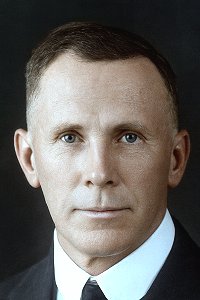
Henry Leo Boles was born near Gainesboro, in Jackson County, Tennessee, on February 22, 1874, and died in Nashville on February 7, 1946. He was raised in a preacher’s home and was connected through his family line to “Raccoon” John Smith. His father was also a gospel preacher, and Boles grew up in an environment shaped by Scripture, preaching, and church life.
His early education came through rural Tennessee schools with short terms, while much of his youth was spent working on the farm. He attended schools in Cannon and Warren Counties, studied at Burritt College, graduated in 1900, later entered Nashville Bible School in 1903, and graduated in 1906. He also earned the M.A. degree from Vanderbilt University in 1920.
Boles married Cynthia Cantrell in 1894. Their son, Cleo, was born in 1895, but Cynthia died four days later. He later married Ida Mae Meiser in 1906, and their son, Leo Lipscomb Boles, was born in 1907. Boles was baptized into Christ on September 27, 1895, and preached his first sermon on June 7, 1903, on “The Human Side of Salvation.”
Though widely known as a preacher, Boles was especially influential as a teacher. He joined the faculty of Nashville Bible School in 1906 and studied daily under David Lipscomb. He taught philosophy, mathematics, logic, ethics, evidences of Christianity, and above all the Bible itself. He trained students to reason from Scripture and resist denominationalism, speculation, and modernism.
He served as president of David Lipscomb College from 1913 to 1920 and again from 1923 to 1932. Over the years, roughly 1,500 young preachers passed through his classes, along with many other students who carried his influence into congregations, homes, and Bible classes.
Boles also became one of the most productive writers among churches of Christ in the first half of the twentieth century. For nearly forty years he wrote for the Gospel Advocate as contributor, editor, and staff writer. He authored commentaries on Matthew, Luke, and Acts, wrote on the Holy Spirit, and produced biographical sketches of gospel preachers to preserve the memory and influence of earlier workers.
He took part in significant doctrinal conflicts of his era, including the Boles-Boll debate on premillennialism and the Boles-Clubb discussion on instrumental music in worship. He opposed denominationalism, modernism, unauthorized innovations, and the softening of biblical authority. He also helped lead the move away from outside lesson-material control when he believed modernist influence was entering Bible class literature.
Boles’ final months were marked by illness, but he continued dictating letters and writing near the end. He died on February 7, 1946, and was buried in Woodlawn Memorial Park in Nashville. The simple inscription at his grave reads, “At Home.” Across his life as preacher, teacher, editor, president, and writer, the unifying thread was his commitment to the authority of the word of God.