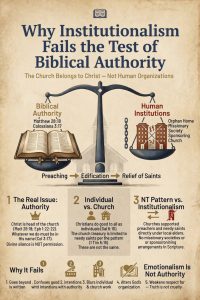
You Do Need CENI: Biblical Authority Is Not a Free-for-All
There is a reason people say they believe in biblical authority and then turn around and defend practices the New Testament never authorizes. The problem is usually not that they suddenly hate the Bible. The problem is that they have abandoned the only honest way to determine what the Bible authorizes. Once that happens, “biblical authority” becomes little more than a religious slogan, and men begin justifying whatever seems helpful, effective, or harmless.
The claim is often stated this way: “We do not need CENI.” In other words, we do not need command, example, and necessary inference as a way of determining biblical authority. Some say that is too rigid. Some say it is a man-made pattern. Some say we should just follow broad principles like love, mission, or edification. But once that claim is pressed, it falls apart. If command, example, and necessary inference are rejected, by what method will authority be established? By feelings? By custom? By what seems good? By what is not explicitly condemned? That is not reverence for Scripture. That is the slow replacement of Scripture with human judgment.
The Claim Sounds Persuasive Because People Attack the Label Instead of the Reality
Part of the confusion comes from the fact that the acronym CENI is not found in the Bible. That much is true. But that argument proves nothing. The word Trinity is not in the Bible either, yet men use that word to summarize what Scripture teaches about the Father, Son, and Holy Spirit. The real question is not whether the acronym appears in the text. The real question is whether the concept is how God reveals and binds His will.
And that is exactly what Scripture shows.
God reveals His will by direct statement. God reveals His will by binding examples that show apostolic practice under divine guidance. God reveals His will by conclusions demanded by the text itself. That is not artificial. That is simply how language, communication, and divine revelation work.
When men reject CENI, what they usually mean is this: they do not want to be bound by the full force of biblical revelation. They want room for innovations the text does not authorize. They want silence to mean permission instead of restraint. They want broad religious goals to justify unauthorized religious methods. That is why this is not a minor issue. It is an issue of whether God has the right to say not only what we must do, but also how we know what He has authorized.
What the Text Actually Shows About Authority
The Bible does not teach a reckless approach to worship, work, doctrine, or practice. It teaches reverence for revealed authority.
Colossians 3:17 says, “Whatever you do in word or deed, do all in the name of the Lord Jesus.” That does not mean merely saying the words “in Jesus’ name.” It means acting by His authority. If something is done by the authority of Christ, that authority must be shown. It cannot be assumed. It cannot be invented. It cannot be defended by convenience.
First Corinthians 4:6 says, “so that in us you may learn not to exceed what is written.” That is not the language of theological looseness. That is the language of restraint. God did not leave His people free to move beyond revelation and then baptize the result with good intentions.
Second John 9 is even sharper: “Anyone who goes too far and does not abide in the teaching of Christ, does not have God.” Notice the warning. The danger is not only refusing what Christ taught. The danger is also going beyond it. That destroys the modern claim that silence automatically grants liberty.
Hebrews 8:5 shows that even under the old covenant, God cared about pattern and precision: “See that you make all things according to the pattern which was shown you on the mountain.” Men often talk as if God is indifferent to form so long as the heart is sincere. Scripture does not talk that way. Nadab and Abihu offered strange fire “which He had not commanded them,” and they were judged for it (Leviticus 10:1-2). The issue was not that God had explicitly listed every possible forbidden fire. The issue was that they acted without divine authorization.
That is the whole point. In matters of worship and service to God, authorization matters.
Command, Example, and Necessary Inference Are Not Human Tricks
Some speak as if CENI is an artificial Church of Christ system forced onto the Bible. That is false. It is simply the recognition that divine authority is communicated in the normal ways language communicates.
A command states what God requires. “Repent, and each of you be baptized” (Acts 2:38). “Observe the first day of the week” is not stated in those exact words concerning the Lord’s Supper, but a command can still be direct and plain in many matters.
An approved example shows the apostles and early church acting under divine direction in a way meant to instruct the churches. Acts 20:7 says, “On the first day of the week, when we were gathered together to break bread.” That is not just a random historical note. It shows the disciples gathering on the first day of the week for that purpose. First Corinthians 16:1-2 likewise gives a pattern for the collection on the first day of the week among the churches.
A necessary inference is not guesswork. It is a conclusion that must be drawn if the text is true. Hebrews 7:14 says, “it is evident that our Lord was descended from Judah.” Jesus’ tribal identity is an inference drawn from revealed facts. The writer then argues from that fact concerning priesthood. In Matthew 22:31-32, Jesus proved the resurrection from God’s statement, “I am the God of Abraham, and the God of Isaac, and the God of Jacob.” The resurrection argument depended on what the text necessarily implied. Jesus Himself reasoned that way.
So no, necessary inference is not a human loophole. Christ and the apostles used it.
Where the Error Happens
The error happens when men demand that authority only counts if there is an explicit command stated in the precise form they prefer. But they do not actually live that way. Everyone uses examples and inferences. The question is whether they are sound and necessary.
Take the assembling of the church on Sunday. A man may say, “Where is the command that the church must partake of the Lord’s Supper every Sunday?” But the same man will often admit that Acts 20:7 shows the disciples meeting on the first day of the week to break bread. If every first day of the week is the time the church assembles, and if that is the stated purpose of that assembly, then the conclusion is not arbitrary. It is demanded by the text and confirmed by the pattern.
Take the question of women serving as elders. There is no verse that says, “Thou shalt not appoint a woman as an elder” in those exact words. But the qualifications given in 1 Timothy 3 and Titus 1 are not meaningless filler. They authorize a certain kind of man. That excludes others. Specification includes and excludes. The same principle operates all through Scripture.
Take instrumental music. Ephesians 5:19 and Colossians 3:16 authorize singing. Men say, “The text does not explicitly say not to add an instrument.” But that is a confession of the real issue. They are treating divine silence as permission. Yet Hebrews 7:14 argues the opposite way. Moses “spoke nothing” concerning priests from Judah. Silence did not authorize Judahite priests. Silence excluded them. The same principle still matters.
When men reject CENI, they do not escape interpretation. They just replace disciplined interpretation with selective interpretation.
Positive Biblical Doctrine: How Authority Really Works
Biblical authority is not established by preference, creativity, or mission language. It is established when Christ reveals His will through Scripture, and that will is understood by what He commands, what He shows in approved apostolic practice, and what the text necessarily teaches.
That does not mean every narrative detail is automatically binding. It does not mean every inference is equally strong. It does not mean men may force fanciful deductions onto the text. But it does mean this: when God reveals His will in these ways, faithful people must submit.
This protects the church from innovation. This keeps worship from becoming entertainment. This keeps mission from becoming pragmatism. This keeps benevolence from becoming institutional drift. This keeps men from baptizing their preferences with the words “I think God would be pleased.”
No. God has not left us to guess what pleases Him. He has spoken.
Practical Consequences of Rejecting CENI
If command, example, and necessary inference are not needed, then what stops the church from adding mechanical instruments, church-sponsored institutions, drama teams, women elders, social gospel machinery, or any other innovation men can dress up with a noble motive?
Once the question becomes, “Does this help?” instead of, “Did the Lord authorize it?” the brakes are gone.
That is exactly why this matters. The rejection of CENI is not an innocent academic disagreement. It is usually a gateway argument. It prepares people to excuse unauthorized practices while still claiming respect for biblical authority. It lets men sound conservative while dismantling the very method by which authority is recognized.
And once that method is gone, the church becomes vulnerable to whatever the next generation finds meaningful, effective, or culturally attractive.
Final Warning and Appeal
The real issue is not whether you like the acronym. The real issue is whether you will submit to the ways God has chosen to reveal His will.
If command, example, and necessary inference are dismissed, then biblical authority becomes fog. Men can shape it, stretch it, and manipulate it until it means almost nothing. But if Scripture is truly final, then we must let Scripture govern not only our conclusions, but also our method of arriving at those conclusions.
Do not be embarrassed by precision where God has spoken. Do not apologize for asking, “Where is the authority?” That question is not legalism. It is reverence.
God did not call His people to sincerity without submission. He did not call the church to creativity without authorization. He did not tell us to honor Christ while refusing to be governed by His revealed will.
So yes, biblical authority requires what men summarize as CENI. Call it command, example, and necessary inference. Call it respecting revelation. Call it not going beyond what is written. But do not throw it away.
Once you throw that away, you do not end up with a deeper respect for Scripture.
You end up with man ruling where Christ alone must rule.