John 19:17–22
Faces in the Crowd at Golgotha
A teaching reflection on the King whom everyone saw—but not everyone recognized.
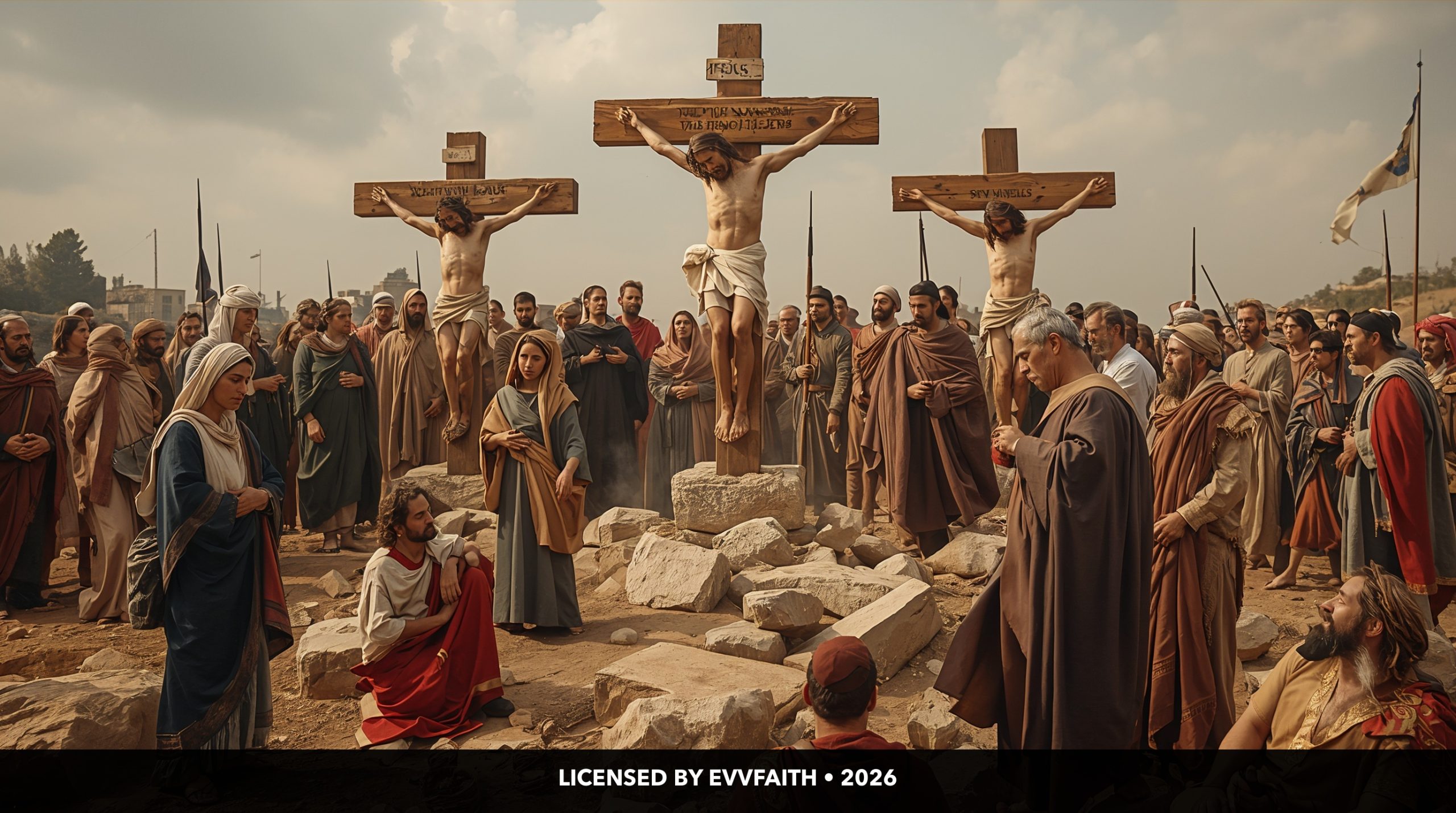
Golgotha: every face sees the cross; every heart must answer the King.
John 19:17 says, “And bearing His own cross, He went out…” The Greek word translated went out is ἐξῆλθεν (exēlthen), from exerchomai—“to go out” or “to come out.” John does not present Jesus as a helpless man being dragged toward an unexpected ending. Jesus went out, bearing His own cross.
He went out to Golgotha—the Place of a Skull. The scene fits the biblical pattern of the sin offering taken outside the camp. Hebrews says, “Therefore Jesus also, that He might sanctify the people through His own blood, suffered outside the gate” (Hebrews 13:12).
Jesus went out carrying the cross, bearing the reproach of sinners, carrying the burden of sin away from the people.
The Photograph
Imagine that someone took a photograph at the moment Jesus arrived at Golgotha. The photograph would show three crosses. Jesus would be in the center.
Around Him would be Roman soldiers, religious leaders, women, disciples, criminals, passersby, pilgrims, and curious spectators. Every face would have something happening behind it.
We cannot know exactly what every person was thinking. But we know what some were saying, and their words give us a glimpse into their hearts.
The Sign Above Him
Above Jesus’ head was a message visible to the world:
JESUS THE NAZARENE, THE KING OF THE JEWS
ἸΗΣΟΥΣ ὁ ΝΑΖΩΡΑΙΟΣ ὁ ΒΑΣΙΛΕΥΣ ΤΩΝ ἸΟΥΔΑΙΩΝ
IESVS NAZARENVS REX IVDAEORVM
ישוע הנצרי מלכא דיהודאי
The words were placed where people could see them. Pilate meant to identify Jesus’ supposed crime. God used the sign to announce Jesus’ true identity.
Pilate meant to mock. God made him proclaim. The King was being announced in the languages of the local people, the wider world, and the Roman power structure.
The educated could read it. The ordinary person could hear it explained. The Jew could read it. The Roman could read it. The Greek-speaking traveler could read it.
“The message was not hidden: the Nazarene is King.”
The Faces in the Photograph
The Soldier with the Wine and Myrrh
Mark says they offered Jesus wine mixed with myrrh, but He did not take it. Perhaps the soldier thought, “Why would anyone refuse relief?” Jesus would not allow His mind to be clouded. He would drink the Father’s cup fully and consciously. [1]
The Soldier with the Sour Wine
Later, another soldier raises sour wine to Jesus’ mouth on hyssop. One drink Jesus refuses. Another He receives. He refuses the drink that would dull His suffering, and receives the drink that fulfills Scripture. [2]
The Soldier Preparing the Nails
He may have been thinking, “This is another execution.” But this was not another prisoner. The King was going to the cross.
The Soldier Dividing the Garments
He saw clothing, not prophecy. Yet his ordinary act fulfilled Scripture as the soldiers divided Jesus’ garments and cast lots for His tunic.
The One Who Asked, “Where Is Judas?”
Judas had brought the soldiers to Jesus and identified Him with a kiss. Someone may have looked around and wondered, “Where is the man who brought us here?” Judas had been close to Jesus, but he did not remain with Jesus. [3]
Mary, the Mother of Jesus
She is looking at the Son she carried and raised. She remembers Simeon’s words: “A sword will pierce even your own soul.” She cannot rescue Him or explain the moment. She can only stand near Him—and she does.
John
John is close enough to hear Jesus say, “Behold, your mother!” John may have wanted to sit beside Jesus in glory. Now he stands beside Him in shame. Jesus gives him responsibility in the middle of the crucifixion, and John obeys. [4]
Mary Magdalene
She had received mercy from Jesus and now watches Him receive cruelty from others. She cannot stop the cross, but she remains near the One who changed her life.
The Other Women
Mary, the wife of Clopas; Salome; the mother of James and John; and other women from Galilee stand nearby or watch from a distance. They cannot answer every question, but they do not leave.
Simon of Cyrene
Simon was coming in from the country when soldiers forced him to carry Jesus’ cross. He may have thought, “Why me?” But Luke says he carried the cross “behind Jesus.” Simon thought he was carrying Jesus’ cross. Jesus was carrying Simon’s sin. [5]
The Criminal Asking for Mercy
One criminal says, “Jesus, remember me when You come in Your kingdom.” He sees a King where others see a defeated man.
The Criminal Demanding Relief
The other criminal wants Jesus to save him from the cross but does not surrender to Him as King. He wants rescue without repentance.
The Religious Leaders
They know the Scriptures and Jesus’ claims, yet they say, “We have no king but Caesar.” They would rather protect their position than submit to God’s King.
The Passersby
They mock Jesus and say, “Save Yourself!” They cannot understand that Jesus’ refusal to save Himself is the very way He saves others.
The Centurion
He begins the day looking at Jesus as a condemned man. He ends it saying, “Truly this was the Son of God!” The execution officer becomes a witness.
The Silent Faces
Some faces say nothing. Mary, John, the women, and Jesus’ acquaintances do not have every thought or word recorded. But their presence says something: they remain near Jesus when they cannot yet understand everything.
The King in the Center
Above His head is the message visible to the world. Pilate meant to identify Jesus’ supposed crime, but God used the sign to announce His true identity.
The priests want the wording changed. They want Pilate to write that Jesus merely claimed to be King. But Pilate answers, “What I have written, I have written.”
The cross does not make Jesus King. It reveals that He already is King.
The One who is thinking about forgiveness is the King. The One who is thinking about His mother is the King. The One who is fulfilling Scripture is the King. The One who refuses to escape is the King. The One who gives His life willingly is the King.
Where Is My Face?
Now imagine the photograph hanging in a museum. The title underneath it reads:
Faces in the Crowd at Golgotha
People stand in front of the photograph studying the faces. But then the question changes.
Where would my face be?
Would I be standing with the crowd—watching but remaining uncommitted? Would I be among the religious leaders—defending my position while rejecting the King? Would I be like Pilate—knowing the truth but protecting my reputation?
Would I be like the soldiers—close to Jesus physically but treating Him as merely another assignment? Would I be like the criminal who wanted relief but not surrender? Would I be like the other criminal—admitting my guilt and asking the King for mercy?
Would I be like Mary—hurting but remaining near Him? Would I be like John—receiving Jesus’ word and accepting responsibility? Would I be like Simon—initially carrying an unwanted burden but finding myself walking directly behind Jesus?
Would I be like the centurion—beginning the day looking at Jesus as a condemned man and ending it confessing who He really was?
The photograph would capture every face. But the cross exposes every heart.
“The question is not merely, ‘What did they see?’ The question is, ‘What did they do with the King they saw?’”
The cross does not merely show us what happened to Jesus. It shows us what is happening inside us when we look at Jesus.
Where is my face in the photograph?