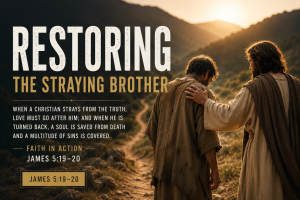
PM 06-28 Confessing and Restoring Together
Text: Galatians 6:1–2
Series: Living the Word: Faith in Action (James)
Date: June 28, 2026
Speaker: Ed Rangel
Location: Waupaca Church of Christ
Bible Version: NASB 1995
Sermon Type: Expository
Learning Objectives
By the end of this sermon, the hearer should be able to:
- State the two duties Paul assigns in Galatians 6:1–2 — restore the fallen in gentleness and bear one another's burdens — and identify what fulfilling them accomplishes.
- Explain the connection between saving a soul from death (James 5:20) and sharing the burdens of the weak (Galatians 6:2).
- Distinguish the burden of sin (requiring confrontation and restoration) from the burden of weakness (requiring practical, patient help).
- Identify one person carrying a burden — whether a burden of weakness or a burden connected to sin — and commit to a concrete, biblical act of help this week.
Thesis
Restoration is love made concrete within the church, and the law of Christ is fulfilled when the body actively carries what the falling or burdened member cannot carry alone.
The most revealing thing about a congregation is not what happens when it gathers on Sunday morning. It is what happens when one of its members falls into sin or collapses under a weight too heavy to carry alone. Watch how a church handles the fallen and the weak. You will see whether they have learned the law of Christ or merely the rituals of religion.
Introduction
- Paul's instruction in Galatians 6:1–2 is precise: who restores, how they restore, and what they must watch in themselves while doing it.
- James 5 and Galatians 6 are twin texts. James commands turning the straying one back. Paul commands the posture, the method, and the larger pattern of burden-bearing the church is called to sustain.
- Together they describe a congregation where sin is confronted gently, burdens are shared consistently, and love is expressed not in sentiments but in presence and action.
- The law of Christ is not an abstraction. It is fulfilled right here — in the hard, unglamorous work of staying close to the fallen and carrying what the weak cannot lift.
I. Restoration Requires Spiritual People (Galatians 6:1)
A. Not everyone is spiritually prepared to lead the work of restoration.
- "You who are spiritual" — those walking in the Spirit, governed by the fruit of the Spirit (Galatians 5:22–23). a. A restorer governed by the flesh will approach the work through force, shame, or condescension. b. The work requires someone whose spirit is aligned with Christ before the first conversation begins. c. The Spirit-led member brings the right spirit before the first word is spoken.
- The spiritual qualification is not mere seniority or title. It is character formed by the Spirit's work. a. A person with the right title but the wrong spirit is not prepared for this work; and a person without a title may still help restore when he approaches with humility, wisdom, and faithfulness. b. God-given roles matter, but no role excuses a fleshly spirit.
B. The restorer must guard himself.
- "Each one looking to yourself, so that you too will not be tempted" (Gal 6:1). a. The fallen brother may not be as different from you as pride wants to believe. b. Temptation has power over the one who goes to him too — whether it is the same temptation, or the pride and harshness that often rise in the restorer’s own heart.
- Humility is not optional here — it is structural. a. Pride in the restorer kills the restoration before it begins. b. The self-aware man who knows his own vulnerability approaches with a spirit that opens doors rather than closing them. c. James 4:6 stands behind this: "God is opposed to the proud, but gives grace to the humble."
II. Restoration Requires a Spirit of Gentleness (Galatians 6:1)
A. Restoration must be done in a spirit of gentleness.
- Πραΰτητος (prautētos) — gentleness, meekness, strength under control; not weakness or avoidance. a. This is not the same Greek word James uses in James 3:17, but it belongs to the same spiritual family: heavenly wisdom is gentle, reasonable, and full of mercy. b. Gentleness in restoration does not mean silence about sin. It means speaking truth without cruelty.
- The goal governs the manner. a. The goal is restoration — καταρτίζω (katartizō), meaning to mend, restore to former condition, set right what has been broken. b. A mender does not punish the torn net. He repairs it so it can serve its purpose again. c. The restorer's goal is a functioning member of the body — not a lesson delivered, not a confrontation won.
B. Gentleness does not mean avoidance.
- The text commands restoration. "Restore such a one" is an imperative. a. This is not an option reserved for the spiritually courageous. It is assigned to the spiritual. b. A church that avoids confrontation out of politeness has confused gentleness with cowardice.
- Failing to restore is itself a failure of love. a. Watching a brother carry the weight of unchallenged sin while you say nothing is not kindness. b. Intervention done gently — with prayer, with humility, with the text — is the most loving thing the body can do for a falling member. c. The brother who is left alone to stray may drift farther than anyone expected, and the longer he wanders, the harder the road back often becomes.
III. Restoration Requires Burden-Bearing Love (Galatians 6:2)
A. The law of Christ is fulfilled in concrete burden-bearing.
- "Bear one another's burdens, and thereby fulfill the law of Christ" (Gal 6:2). a. The law of Christ is the rule of love taught, embodied, and commanded by Christ — what James calls the royal law, and what Jesus states plainly: "love one another, even as I have loved you" (John 13:34). b. Burden-bearing is not a supplement to love. It is the form love takes when a brother is being crushed.
- The burdens here are heavy weights — βάρη (barē) — that overwhelm the individual carrying them. a. Not every inconvenience. Not every disappointment. The loads that crush. b. Sickness that will not lift. Grief that has no floor. Temptation pressing beyond endurance. Discouragement that has become despair. c. These are not managed from a distance. They require presence.
- Paul is not denying personal responsibility. In verse 5 he will say each one bears his own load. But here he speaks of crushing burdens that call for the help of the body.
B. Appropriate confession and mutual intercession belong inside burden-bearing.
- James 5:16 — "Confess your sins to one another, and pray for one another so that you may be healed." a. You cannot bear a burden you do not know about. The church that never shares burdens has built walls where the text commands doors. b. Appropriate confession and mutual intercession are tools by which the body carries what individuals cannot carry alone.
- One of the highest forms of burden-bearing is helping turn a soul back from death. a. To carry someone through a crisis of sin back to faithfulness — to stay with them through repentance and restoration — is the law of Christ in its fullest expression. b. One of the greatest burdens you can help someone carry is the weight of returning from wandering.
Application
For the individual: Consider what it would mean to be genuinely available to a struggling brother or sister in this congregation — not available on your own terms, in your comfort zone, at a safe distance — but present in someone's difficulty. The law of Christ calls for that kind of love. Does your current Christian life include it? Is there someone right now whose burden you could help carry, and you have been choosing not to?
For the church: Is this congregation a place where someone can fall and be restored, or is it a place where someone falls and disappears? That answer is not formed on Sunday mornings. It is formed by the quality of relationships that exist or do not exist among these members during the week. If the only contact between members is the Sunday assembly, burden-bearing in any meaningful sense is impossible. You cannot carry what you do not know. And you cannot know what you are never close enough to see.
For parents and the next generation: The generation rising in this church will inherit either a culture of mutual accountability or a culture of polite distance. If children grow up watching adults confront one another gently and restore one another faithfully, they will understand that belonging to the church means something. They will know that if they fall, someone will come for them. Teach them to carry one another's burdens. Let them see you do it. Let them know that love in this church has hands.
Conclusion
- Galatians 6:1–2 gives the church two assignments.
- Restore the fallen.
- Carry the weak.
- Both require spiritual qualification.
- Both require humble self-examination.
- Both require a spirit of gentleness.
- Not because the commands are soft.
- Because the goal is restoration, not punishment.
- The law of Christ is fulfilled when love is concrete.
- Not in a feeling.
- Not in a statement of concern.
- But in the actual work of showing up for a struggling brother and staying.
- This is faith in action.
- This is where the letter of James ends.
- This is what the church is for.
Invitation
If you are carrying a burden today that has become too heavy — sin that is undealt with, grief that has isolated you, discouragement that has made you go quiet — the church you are sitting in is commanded by God to help you carry it. But that begins with your willingness to let the body in. Come forward. Be honest. Receive what God has placed here for you.
If you are outside of Christ, your greatest burden is sin that has never been addressed at its root. Christ does not offer to help you manage it. He offers to forgive it by the blood He shed at the cross. Hear the gospel. Believe that Jesus is the Christ, the Son of God. Repent. Confess His name. Be baptized for the remission of your sins. Come to Him now.
Word Study
| Word | Original | Meaning | Use in Text |
|---|---|---|---|
| Restore | καταρτίζετε (katartizete) | To mend, restore to proper condition, equip for function | Galatians 6:1 — the goal of intervention for the fallen member |
| Gentleness | πραΰτητος (prautētos) | Gentleness, meekness, strength under control | Galatians 6:1 — the required spirit in restoration |
| Spiritual | πνευματικοί (pneumatikoi) | Those walking in and governed by the Spirit | Galatians 6:1 — the qualification of the one who restores |
| Burdens | βάρη (barē) | Heavy weights, crushing loads | Galatians 6:2 — loads too heavy for one person to carry alone |
| Law of Christ | νόμον τοῦ Χριστοῦ (nomon tou Christou) | The rule of love taught and embodied by Christ | Galatians 6:2 — fulfilled in concrete burden-bearing for one another |
Scripture Interlock Table
| Testament | Reference | Original Context | Connection to Main Text | Doctrinal Use | Sermon / Teaching Use |
|---|---|---|---|---|---|
| NT | James 2:8 | The royal law: "You shall love your neighbor as yourself" | Identifies what the law of Christ in Galatians 6:2 fulfills | Love is not abstract — it governs concrete action toward the struggling brother | Preacher can connect the law of Christ directly to the royal law James names |
| NT | James 5:16 | Mutual confession and intercession for healing | Shows that burden-bearing in the church includes appropriate confession and accountable prayer | Appropriate confession and intercession are part of how burdens are carried together | Grounds the series text into the PM application |
| NT | James 5:19–20 | Turning a straying brother back from death | Shows the ultimate form of burden-bearing: staying with someone through repentance | The highest work of the burden-bearer is helping turn a soul back from spiritual death | Bridges the AM sermon into this PM application |
| NT | John 13:34–35 | Jesus commands His disciples to love one another as He has loved them | The law of Christ in Galatians 6:2 echoes this command | Burden-bearing is not a program — it is Christlike love expressed in presence | Preacher can show that the law being fulfilled is not the Mosaic law but Christ's own command |
| NT | Galatians 5:22–23 | The fruit of the Spirit — love, joy, peace, gentleness, self-control | The "spiritual" restorer of Galatians 6:1 is one bearing these fruits | The qualification for restoration is character formed by the Spirit, not position in the church | Anchors Point I on the Spirit-formed restorer |