Faith in Action
Author: Ed Rangel Series: Living the Word Church: Waupaca Church of Christ
Table of Contents
- Faith in Action
- Dedication
- Publication & Usage Notice
- How to Use This Workbook
- Key Themes in James
- Master Cross-Reference Guide
- Module 01 – The Crucible of Joy
- Module 02 – The Anatomy of Temptation
- Module 03 – Faith That Listens and Lives
- Module 04 – The Royal Law
- Module 05 – Faith and Works
- Module 06 – Teachers and the Tongue
- Module 07 – Wisdom from Above
- Module 08 – Conflict & Humility
- Module 09 – Arrogance & God’s Will
- Module 10 – Wealth & Injustice
- Module 11 – Patience in Suffering
- Module 12 – Prayer & Restoration
Dedication
To my beloved wife, Jeny Tobón-Sánchez, My suitable helper and my crown (Genesis 2:18; Proverbs 12:4). Your love, support, and patience are a constant reflection of the grace of God.
To my daughters, Rochelle Lynne, Valerie Nichole, and Arianna Jade, And to my son, John Paul (George). Through your love, your questions, and your simple way of living, you have preached countless sermons to me without ever stepping behind a pulpit. You continually teach me the meaning of simple faith, the necessity of patience, and the wonder of viewing the world through trusting eyes.
May the word of Christ richly dwell within you (Colossians 3:16), and may you always walk in the truth (3 John 4).
Soli Deo Gloria.
Publication & Usage Notice
© 2025 Ed Rangel. All rights reserved.
No part of this book may be reproduced, stored in a retrieval system, or transmitted in any form or by any means without the prior written permission of the publisher, except for brief quotations used in reviews, teaching, or group study with proper citation.
Publisher: Keeping the Faith Website: www.edrangel.com Contact: rangellalo@gmail.com
Scripture Quotations Scripture quotations are from the New American Standard Bible (NASB) 1995 Updated Edition, © The Lockman Foundation. Used by permission. All rights reserved.
How to Use This Workbook
What You’ll Need
| Item | Purpose |
|---|---|
| Bible (NASB 1995 preferred) | Primary text for study. |
| Pen/Fine-Tip Marker | Margin notes, underlining. |
| Workbook/Notebook | Written responses, reflections. |
| Open Heart & Mind | Receptiveness to learning. |
Preacher Ed's Bible of Choice
NASB '95 Large Print Wide Margin - Paste-Down Cowhide (Available from 316publishing.com)
Why Ed Loves It:
- Extra-Wide Margins: 1.5 inches for extensive note-taking.
- Premium Paper: 40 gsm prevents bleed-through with Micron pens.
- Single-Column: Clean, uncluttered layout.
Unlock Your Margins: Tips From Ed
| Technique | Purpose |
|---|---|
| Underline Key Words | Emphasis, quick identification. |
| Date Your Insights | Track personal growth and context. |
| Link Passages | Cross-referencing for deeper understanding. |
| Use Symbols | Visual cues (e.g., ! for warning, * for encouragement). |

Ed’s Study Essentials
Must-Haves
- Reliable Wide-margin Bible
- Micron Pens: No bleed-through, archival quality.
- Hardbound Journal: Dedicated space for deeper reflections.
Hold Up! This isn't a casual read. James is intense. Expect challenges, tough questions, and conviction. Don’t rush. Pause. Pray. Press in.
Key Themes in James
| Key Theme | Description |
|---|---|
| Trials and Spiritual Maturity | Tests refine us. Trials develop endurance (1:2–4). |
| Poverty and Wealth | The humble are rich in faith; the wealthy are warned (1:9–11; 5:1–6). |
| Doers of the Word | True religion manifests in actions (1:22–25). |
| Caring for the Vulnerable | Visit orphans and widows; guard your heart (1:27). |
| Impartiality | Favoritism fractures community (2:1–13). |
| Living Faith | Faith is a living force demonstrated through works (2:14–26). |
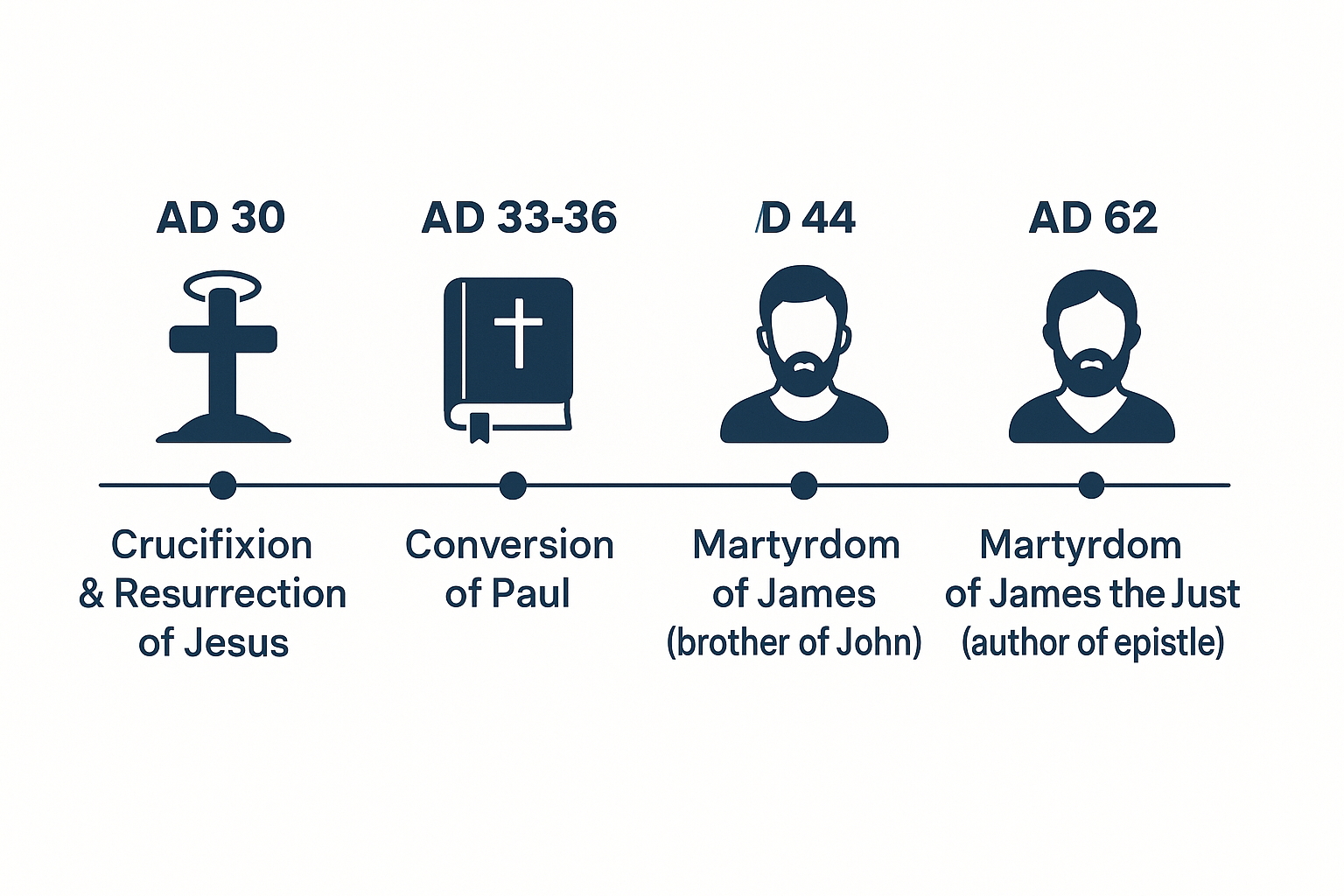
Master Cross-Reference Guide
| Verse | Cross References | Key Themes / Notes |
|---|---|---|
| 1:1 | Acts 15:13; Rom 1:1; 1 Pet 1:1 | Servant identity; the dispersion. |
| 1:2 | Matt 5:10-12; Rom 5:3; 1 Pet 1:6 | Joy in trials; Beatitudes echo. |
| 1:3 | Rom 5:3-4; 1 Pet 1:7 | Testing produces perseverance. |
| 1:4 | Matt 5:48; Eph 4:13 | Maturity and completeness. |
| 1:5 | 1 Kings 3:9; Matt 7:7 | God's generous giving of wisdom. |
| 1:6 | Matt 21:21; Heb 11:6 | Faith without doubt. |
| 1:12 | Rev 2:10; 2 Tim 4:8 | Crown of life for perseverance. |
| 2:1 | Acts 10:34; Rom 2:11 | Faith incompatible with partiality. |
| 2:8 | Lev 19:18; Matt 22:39 | The Royal Law: Love neighbor. |
| 2:26 | Gen 2:7; Eccl 12:7 | Faith without works is dead. |
Hook: When the Furnace Door Closes
You can talk about faith when the sun is out. You can sing about joy when the bills are paid, the house is calm, and the body feels strong. But James opens this letter by walking Christians into a furnace and telling them what to do when the door shuts.
Trials do something simple and brutal: they remove options. They strip away control. They expose what you truly trust. When pressure rises, you do not rise to the level of your good intentions—you sink to the level of what is actually formed in you.
James does not begin with comfort. He begins with formation. He teaches Christians how to think while hurting, how to pray while confused, how to keep walking while tired, and how to value what God is producing more than what pain is taking.
This is not a letter for spectators. It is for Christians who mean to finish.
Memory Verse
James 1:2 (NASB 1995) — “Consider it all joy, my brethren, when you encounter various trials.”
Learning Objectives
- Define the purpose of trials in the life of a believer (testing produces endurance).
- Identify the specific wisdom required to navigate suffering and how to ask for it.
- Contrast the temporary nature of wealth with the eternal status of the humble brother.
- Explain the "Crown of Life" as the reward for those who persevere.
James 1:1 — The Sender, the King, and the Scattered
Before James gives commands, he gives identity. He begins with a name and a title. This is not small talk. It tells you how to read everything that follows.
“James, a bond-servant of God and of the Lord Jesus Christ.” James does not introduce himself as “the Lord’s brother.” He does not lean on family honor. He stands as a servant. That word means he belongs to Another. His will is not the highest will. His plans are not the final plans. This is the posture James will demand from Christians throughout the letter.
Notice the twofold allegiance: God and the Lord Jesus Christ. James does not treat Jesus as an assistant or a second-tier authority. Jesus is Lord. That matters because trials tempt Christians to think God has lost control. James anchors them: God reigns, and Jesus is Lord, even when life feels like it is falling apart.
“To the twelve tribes who are dispersed abroad.” These are God’s people living scattered lives. Their geography is unstable, but God’s claim is stable. They have been pushed out, but they have not been pushed away from God.
The scattering is not only political. It is spiritual pressure. Displacement brings new temptations: bitterness, fear, compromise, quick anger, jealousy, envy, and the craving for comfort at any cost. James writes to form Christians who can live holy lives when their lives are not easy.
“Greetings.” The greeting is short because James has urgent work to do. He is not entertaining. He is training.
Introduction: The Unwelcome Guest
We begin our study of James not with a theological treatise, but with a collision. James does not open by soothing wounded feelings; he opens by commanding disciplined thinking. James 1:1–12 is a furnace, not a cushion. He addresses the “twelve tribes who are dispersed abroad”—Jewish believers pressed by persecution, displaced from familiar life, learning what it means to follow Christ when the world is not friendly.
James does not say trials are good in themselves. He does not pretend pain is pleasant. He does not tell them to call evil “good.” He tells them to count—to evaluate, to reckon—to take the trial and put it in the ledger under God’s providence, and to view it as an instrument that produces something God wants formed in them.
This is where James sets the tone for the whole epistle: faith that is real will show itself under pressure. The first test is not outward—it's mental and spiritual. Can you hold a biblical worldview while you hurt? Can you speak like a believer when you feel like a victim? James is training the mind and strengthening the spine.
James 1:2 — The First Command: A Decision of the Mind
James starts with the mind because the mind directs the life. He does not begin by saying, “Here is how to escape.” He begins by saying, “Here is how to think.”
“Consider it all joy.” This is not “enjoy the pain.” This is “judge the trial by what God is producing through it.” It is a decision of the will before it is a feeling of the heart. James is commanding Christians to bring their thoughts under obedience to God when emotions are loud.
“My brethren.” James speaks with firmness, but not coldness. He is not shaming them. He is calling them to family loyalty. Trials tempt Christians to isolate. James pulls them back into shared identity and shared duty.
“When you encounter various trials.” Trials are not optional. They are encountered. They are met on the road. The word “various” tells you they are not one-size. Some trials are public. Some are private. Some are sudden. Some are long. Some attack the body. Some attack relationships. Some attack the mind. But all trials share one feature: they reveal what is in you.
This verse is the doorway into the rest of the paragraph. James is not giving a motivational poster. He is giving a battle order. Christians must decide ahead of time: when the hard thing comes, God will still be trusted, and obedience will still be chosen.
I. The Command: Count it Joy
Text: James 1:2–4 (NASB 1995)
James wastes no time. He commands us to consider (ἡγήσασθε) our trials as all joy. This is an accounting term; it means to evaluate the "ledger" of our suffering and decide, by an act of will, to categorize it as an asset rather than a liability.
James is not commanding a mood. He is commanding a verdict. Christians can obey this command even while tears are real, sleep is short, and strength is low. The command is about what you decide the trial means under God.
Trials will always preach a message. Pain preaches, fear preaches, loss preaches, and delay preaches. James teaches Christians to reject the trial’s sermon and accept God’s sermon.
A. “Consider” is not denial—it's judgment
James is not asking for emotional pretending. He is commanding a judgment call. Your feelings will often call the trial “loss.” James says the mind must look at the trial through God’s purpose.
- Pain-centered thinking: “This is ruining my life.”
- God-centered thinking: “This is refining my faith.”
Counting it joy is not calling suffering “sweet.” It is saying, “God can use this to produce maturity I cannot get any other way.”
James is teaching Christians to practice spiritual leadership over their own minds. If you do not lead your thoughts, your thoughts will lead you. And in a trial, your thoughts will drag you toward despair, anger, complaint, or compromise if they are not disciplined.
This is where free will matters. James does not treat Christians like robots. He does not say, “God will force joy into you.” He gives a command because the Christian can obey it. A Christian can refuse bitterness. A Christian can choose gratitude. A Christian can choose endurance. The trial is not the master. God is the Master, and the Christian must submit to God’s purpose.
B. “Various trials” means no area is exempt
The word “various” (ποικίλοις) is the idea of many-colored, many-shaped tests. James is not talking only about persecution. Trials include:
- health decline,
- financial strain,
- family stress,
- conflict,
- loneliness,
- disappointment,
- unanswered plans,
- spiritual opposition,
- and the long grind of endurance.
Some trials are sudden; some are slow. But they all expose what is in us.
Trials also come in different “weights.” Some are heavy enough to break routines. Some are light enough to be ignored—until they quietly shape your heart. Small irritations can train a Christian into a complaining spirit. Long pressures can train a Christian into cynicism. James speaks to “various trials” because spiritual formation happens in big moments and in repeated moments.
C. The logic: testing → endurance → maturity
The reason is functional: the testing of faith produces endurance (ὑπομονήν). This is not passive waiting; it is "remaining under" the weight without collapsing. God is not only concerned with whether you “believe,” but whether your faith can stand under load.
And James goes further: endurance must be allowed to have its perfect result. This implies a danger: believers often want the trial to end before it finishes producing what God intends. James is saying, “Don’t abort the process.” When endurance completes its work, the believer becomes “perfect and complete, lacking in nothing”—not sinless perfection, but maturity, wholeness, stability.
James’s logic is simple and surgical:
- Trial exposes what you actually trust.
- Testing proves what is real and what is only talk.
- Endurance is formed when a Christian chooses obedience repeatedly under pressure.
- Maturity is the product—steady faith, steady worship, steady character.
Endurance is not instant. It is built. It is built the same way muscles are built: resistance, repetition, strain, recovery, and continued effort. A Christian cannot “download” endurance. Endurance is formed in the furnace.
D. The hidden issue: shortcuts
- shortcuts in suffering (“Get me out NOW”),
- shortcuts in holiness (“Give me instant growth”),
- shortcuts in character (“Fix me without changing me”).
But God often grows a believer through time, pressure, and repetition. Endurance is formed by remaining faithful when it would be easier to quit.
Shortcuts look spiritual, but they are often unbelief dressed up. Some Christians try the shortcut of denial: “I’m fine,” while the heart is collapsing. Some try the shortcut of blame: “If people were better, I would be better.” Some try the shortcut of escape: endless distraction, endless entertainment, endless numbing. James is not allowing any of that. He is forming Christians who can face hard things with clean hands and a steady heart.
Word Focus
| Term | Greek | Meaning | Explanation |
|---|---|---|---|
| Consider | ἡγήσασθε (hēgēsasthe) | A command to lead the mind | A deliberate judgment to classify trials as purposeful rather than pointless (James 1:2). |
| Various | ποικίλοις (poikilois) | Multi-colored | Trials differ in form, intensity, and duration; no area of life is exempt. |
| Endurance | ὑπομονήν (hupomonēn) | Remaining under | Faithful perseverance that holds steady while pressure remains. |
Key Takeaways
- Joy is not a reaction to pain; it is a verdict on purpose.
- God is more interested in your character than your comfort.
- You cannot have a "perfect work" without the work.
- The trial is not meant to destroy faith—it is meant to reveal and refine it.
James 1:3–4 — What God Is Producing When You Stay Under It
James explains why the command makes sense: “knowing that the testing of your faith produces endurance.” Christians are not guessing in the dark. James says Christians can “know” what trials are doing when trials are received in faith.
Testing is not the same as temptation. Testing is pressure that reveals and proves. God tests faith the way fire tests metal: not to destroy what is real, but to expose what is false and strengthen what is true.
Faith produces endurance when the Christian keeps obeying instead of quitting. Endurance is not stubbornness. Endurance is faithfulness. It is continuing to do right even when doing right costs you.
Then James gives another command: “And let endurance have its perfect result.” That means endurance can be interrupted. Christians can stop the process. They can harden. They can turn back. They can compromise. They can blame God. James is warning Christians not to sabotage their own growth.
“So that you may be perfect and complete, lacking in nothing.” James is describing a whole Christian. A stable Christian. A Christian with depth. A Christian who is not easily moved. A Christian who does not break when pressure comes because something solid has been built inside.
II. The Resource: Wisdom for the Asking
Text: James 1:5–8 (NASB 1995)
James knows what trials do to the mind. Pressure narrows vision. Fear clouds judgment. Pain pushes Christians toward reaction instead of obedience. So James gives the resource God provides for surviving trials without spiritual damage: wisdom.
James does not say, “If you lack relief.” He does not say, “If you lack answers.” He says, “If any of you lacks wisdom.” The problem in trials is not mainly ignorance of facts; it is lack of discernment about how to live faithfully while suffering.
Wisdom is not information. Wisdom is skill for obedience. Wisdom answers the question: “What does faithfulness look like right now?”
A. What wisdom actually is
In Scripture, wisdom is the ability to apply God’s truth to real situations. It is the skill of making godly decisions when emotions are loud and circumstances are confusing.
Wisdom asks practical questions:
- What obedience is required right now?
- What temptation is hiding inside this trial?
- What attitude will honor God here?
- What response will protect my soul?
- What must I endure rather than escape?
James is teaching Christians that trials require wisdom because trials create moral danger. Pressure can push a Christian toward anger, self-pity, bitterness, revenge, compromise, or despair. Wisdom guards the soul while endurance is being formed.
B. The invitation: ask God
James’s instruction is simple: “Let him ask of God.” Wisdom is not earned. It is requested. God does not hide wisdom behind spiritual achievement. He offers it to those who know they need help.
Asking assumes humility. A Christian who asks for wisdom is admitting, “I do not trust my instincts right now.” Trials expose how dangerous self-reliance really is.
James emphasizes God’s character as the giver:
- God gives generously.
- God gives without reproach.
God is not annoyed by repeated requests. He does not shame Christians for needing help. He does not say, “You should know better by now.” He gives wisdom freely to those who genuinely seek to obey Him.
C. “Without reproach” — no humiliation attached
The phrase “without reproach” means God does not scold the asker. Human help often comes with strings attached: reminders of past failures, comparisons, impatience. God does not operate that way.
A Christian may ask God for wisdom again and again in the same trial. God does not withdraw His patience. Wisdom is not rationed. God’s generosity matches His holiness.
D. The condition: ask in faith
James adds a serious warning: wisdom must be asked for in faith, without doubting. Doubting here does not mean momentary fear or emotional struggle. It means divided loyalty.
The doubter is described as a wave of the sea—driven by the wind, unstable, unpredictable. This is the Christian who asks God for wisdom while secretly reserving the right to disobey if obedience becomes uncomfortable.
Faith means submission before the answer is given. Faith says, “I will obey whatever God shows me.” Doubt says, “I will obey if I like the answer.”
E. Double-mindedness: the real danger
James introduces a critical word: δίψυχος—double-minded, literally “two-souled.” This describes a Christian who wants God and wants self-rule at the same time.
Double-mindedness does not stay contained. James says the double-minded person is unstable in all his ways. Division in loyalty produces division everywhere:
- in decisions,
- in relationships,
- in moral boundaries,
- in endurance,
- in worship.
God does not refuse wisdom to sincere Christians. He refuses to be treated as a consultant instead of Lord.
Word Focus
| Term | Greek | Meaning | Explanation |
|---|---|---|---|
| Wisdom | σοφία (sophia) | Skillful judgment | The ability to apply God’s truth to real-life decisions under pressure. |
| Generously | ἁπλῶς (haplōs) | Openly, without reserve | God gives wisdom freely, without hidden conditions. |
| Doubting | διακρινόμενος (diakrinomenos) | Being divided internally | Wanting God’s help without full submission. |
| Double-minded | δίψυχος (dipsuchos) | Two-souled | A divided loyalty that produces instability in faith and obedience. |
Key Takeaways
- Wisdom is for obedience, not curiosity.
- God gives help without humiliation.
- Faith submits before answers arrive.
- Divided loyalty produces unstable living.
James 1:5–8 — Why Faith Must Be Settled Before the Trial Ends
James is teaching Christians that wisdom is not optional equipment for suffering—it is essential protection. Trials will force decisions. Without wisdom, Christians will choose relief over righteousness.
Faith settles the question of authority before the pressure increases. A Christian who decides ahead of time to obey God will not be shaken as easily when obedience becomes costly.
James’s warning is loving but firm. God does not empower indecision. He strengthens submission. The Christian who commits fully to God’s will will receive wisdom sufficient for every trial.
III. The Perspective: Rich and Poor
Text: James 1:9–11 (NASB 1995)
James now shifts perspective. Trials do not affect everyone in the same outward way, but they reveal the same inward truth. Wealth and poverty respond differently to pressure, yet both are tested by it.
James speaks to two Christians standing in very different circumstances: the brother of humble means and the rich Christian. Both face trials. Both must interpret their situation through faith rather than appearances.
A. The humble Christian’s exaltation
James begins with the Christian of low position. Poverty, in Scripture, is not presented as virtue in itself. Lack of resources can bring anxiety, fear, and vulnerability. Yet James says the humble Christian is to boast—not in poverty, but in exaltation.
The word translated “humble” refers to low status, not humility of character alone. This Christian may be overlooked, marginalized, or struggling to survive. Yet in Christ, his position is elevated. He belongs to the kingdom. He is adopted by God. He is an heir of eternal life.
Trials strip away illusions. Poverty makes dependence visible. The humble Christian is reminded daily that survival itself is not guaranteed. This dependence, while painful, can sharpen faith.
B. The rich Christian’s humiliation
James then addresses the rich Christian. Wealth does not remove a person from trials; it only changes the shape of them. Riches bring their own dangers: self-reliance, false security, delayed repentance.
The rich Christian is told to boast in humiliation—not shame, but sober realism. Wealth fades. Influence disappears. Health declines. Death levels every advantage.
James uses the image of wild grass scorched by the sun. The flower falls. The beauty is gone. The same sun that sustains life also exposes fragility. Wealth does not protect from time, decay, or judgment.
C. Trials reveal what we trust
Trials function as truth tellers. When resources are removed or threatened, confidence is exposed. Poverty tests whether hope is anchored in God. Wealth tests whether trust has quietly shifted from God to provision.
James is not condemning wealth. He is warning against misplaced confidence. Riches tempt Christians to believe they are insulated from suffering, dependent prayer, and urgent obedience.
Trials strip false securities. They reveal whether faith rests in God’s promises or in temporary stability.
Key Takeaways
- Status does not protect from testing.
- Poverty exposes dependence; wealth tests loyalty.
- Everything visible is temporary.
- Trials reveal what we actually trust.
James 1:9–11 — Why Perspective Matters Under Pressure
James teaches Christians to interpret their circumstances through eternity, not emotion. Poverty and wealth are not final conditions. They are passing states within a larger story.
Trials help reorder values. They remind Christians that identity is not tied to comfort, success, or security. Identity is rooted in Christ.
A Christian who understands this perspective can endure loss without despair and blessing without pride.
IV. The Reward: The Crown of Life
Text: James 1:12 (NASB 1995)
James concludes this section with a promise. Trials are not endless. Endurance is not unnoticed. God sees faithfulness that the world ignores.
A. Blessed does not mean comfortable
The word “blessed” describes divine approval, not ease. The blessed Christian is not the one spared from hardship but the one who remains steadfast under it.
James makes clear that blessing comes after endurance—not before it. The trial tests faith. The endurance proves love for God.
B. Approved through testing
The word “approved” describes metal tested by fire and found genuine. Faith that collapses under pressure is exposed as shallow. Faith that endures proves authenticity.
This testing does not earn salvation. It demonstrates genuine trust. Endurance reveals what belief really is.
C. The crown of life
The crown James describes is not an earthly reward. It is the crown of life—eternal life itself. This crown is promised to those who love God, not merely those who suffer.
Love fuels endurance. Obedience continues when emotion fades. Faith holds steady when comfort disappears.
The crown is not for the fastest starter. It is for the faithful finisher.
Key Takeaways
- Endurance precedes blessing.
- Testing reveals authentic faith.
- Eternal life is the promised reward.
- Love for God sustains obedience.
James 1:1–12 — The Foundation of Faith Under Pressure
This opening section of James establishes the tone for the entire letter. Faith is not theoretical. Faith is tested. Faith endures. Faith obeys under pressure.
James does not promise relief. He promises purpose. Trials are not interruptions to the Christian life; they are instruments in God’s shaping work.
Christians who understand this foundation will not be shocked by suffering. They will meet it with settled loyalty, disciplined thinking, and active trust.
Exegetical Workbook: James 1:1–12
This workbook section is designed to force slow thinking, careful reading, and obedient response. Every question is tied directly to the text. Do not rush. James does not reward speed—he rewards endurance.
Verse-by-Verse Observation
-
James 1:1 — Why does James identify himself as a servant rather than an apostle, and how does this shape the authority of his message?
-
James 1:2 — Why does James command a decision of the mind (“consider”) instead of addressing emotions first?
-
James 1:3 — How does testing differ from temptation, and why is this distinction essential for faith?
-
James 1:4 — What does it mean to allow endurance to “finish its work,” and how do Christians often resist this process?
-
James 1:5 — How does biblical wisdom differ from simply wanting answers or relief from pain?
-
James 1:6–7 — Why does divided loyalty make prayer ineffective, according to James?
-
James 1:8 — How does double-mindedness affect areas beyond spiritual life?
-
James 1:9–11 — How do poverty and wealth test faith differently, yet reveal the same issue of trust?
-
James 1:12 — Why does James connect endurance with love for God rather than with endurance itself?
Cross-Reference Analysis
James is not isolated in Scripture. His teaching echoes the consistent message of endurance across both Testaments.
-
Romans 5:3–4 — How does Paul’s progression (suffering → perseverance → character → hope) align with James 1:2–4?
-
1 Peter 1:6–7 — How does Peter describe the purpose of testing, and how does it complement James’s teaching?
-
Hebrews 12:11 — Why does discipline feel painful rather than joyful in the moment, and what does it eventually produce?
Self-Assessment (Interactive)
Rate yourself honestly using the scale below: 1 = Rarely true, 5 = Consistently true.
| Statement | 1 | 2 | 3 | 4 | 5 |
|---|---|---|---|---|---|
| I interpret trials through God’s purpose rather than emotion. | |||||
| I ask God for wisdom with the intention to obey. | |||||
| I remain faithful when relief is delayed. |
Journal Reflection
Describe a current trial that has tested your faith.
How have you been interpreting it?
What wisdom are you asking God for, and what obedience must follow?
Bridge to Module 02
Looking AheadHaving established the purpose of trials and the necessity of endurance, James now turns to a critical clarification. God is not the source of temptation. In the next section, James confronts a dangerous accusation: blaming God for sin. The testing that strengthens faith must be distinguished from temptation that destroys it.
Introduction: The Blame Game
James is not shifting topics casually. He is following a tight theological progression. Trials (vv. 2–12) test faith from the outside; temptation (vv. 13–18) attacks faith from the inside. The same pressure that refines endurance can also expose desire. James knows Christians often confuse the two—and that confusion becomes spiritually fatal when it leads to blaming God.
If trials are pressure from the outside, temptation is pressure from the inside. James now moves from suffering that tests faith to desire that tests obedience. In James 1:13–18, he confronts a common and dangerous habit: blaming God for personal sin.
When obedience is costly, people look for excuses. “God put me here.” “God wired me this way.” “God knew my weaknesses.” James strips away every version of that argument. He does not soften the truth. He does not blame culture, trauma, or circumstance. He locates the problem exactly where Scripture always does: inside the human heart.
This blame-shifting is not accidental. When pain is intense and obedience costly, the human heart looks for theological cover. If suffering comes from God, some reason, then maybe temptation also comes from God. James refuses to allow that logic to stand.
This is an ancient pattern. Adam blamed Eve—and indirectly blamed God who gave her. Eve blamed the serpent. Israel blamed circumstances. Proverbs summarizes it plainly: “A man’s own folly ruins his life, yet his heart rages against the LORD” (Proverbs 19:3). James is exposing that same instinct in Christians.
This section is direct because sin is deadly. James explains temptation step by step so that believers stop excusing it, start recognizing it early, and learn to fight it honestly.
Before James explains how temptation works, he first establishes where it does not come from. Theology must be corrected before behavior can be confronted.
I. The Source: Let No Man Say
Text: James 1:13 (NASB 1995)
James begins with a prohibition. This is not advice. It is a command directed at speech, thought, and internal justification. The phrase “let no one say” forbids both verbal accusation and internal rationalization.
James gives a clear command: no believer is permitted to say, “I am being tempted by God.” The wording implies this was already being said and must stop. Temptation was being re-labeled as divine influence.
This accusation often grows out of a distorted understanding of God’s sovereignty. If God governs all things, some conclude He must also govern temptation. James draws a hard boundary: God may govern trials, but He never authors temptation.
James responds with theology, not psychology. God’s nature settles the matter. God cannot be tempted by evil, and He does not tempt anyone. Testing and tempting are not the same. God tests faith to strengthen it. Temptation aims at sin and separation.
The same Greek root (peirazō) can describe both testing and tempting, but context determines meaning. God’s testing has a redemptive goal: endurance, maturity, crown of life. Temptation’s goal is collapse. God wants His people to pass the test; the tempter wants them to fail. Scripture consistently maintains this distinction (Genesis 22:1; 1 Corinthians 10:13).
If God tempted His people to sin, He would be acting against His own holiness. Scripture never allows that conclusion.
James strengthens his argument by grounding it in God’s moral nature. God is not merely unwilling to tempt; He is unable to be tempted by evil. Evil has no attraction to Him, no leverage over Him, no foothold within Him. Because temptation requires desire, and God has none for evil, He cannot solicit others toward it.
Blaming God for temptation does more than excuse sin—it slanders God’s character and numbs conscience. Once a Christian believes temptation is divinely sourced, resistance feels futile. James cuts that lie off at the root.
Key Takeaways
- God never pushes His people toward sin.
- Blaming God is a refusal to face responsibility.
- A false view of temptation leads to a false view of God.
James insists that responsibility must rest where temptation begins. God is holy, consistent, and good. Any theology that makes Him the source of temptation is deception. Before Christians can fight desire, they must stop accusing God.
II. The Process: Hooked and Dragged
Text: James 1:14–15 (NASB 1995)
Having removed God as the source of temptation, James now traces its actual origin and development. He does not treat temptation as mysterious or uncontrollable. Instead, he maps it like a process that can be identified, interrupted, and stopped—if it is recognized early.
If temptation does not come from God, where does it come from? James answers plainly: from within. Every person is tempted when he is carried away and enticed by his own lust. The source is internal desire, not external pressure.
James stresses personal responsibility by using possessive language: his own lust. This is not generic temptation floating in the air. It is individualized. Each Christian must confront the desires that specifically pull him or her.
James uses hunting and fishing language to describe temptation. The sinner is not attacked; he is drawn. The danger looks attractive. The hook is hidden.
This imagery exposes a critical truth: temptation does not force itself on anyone. It persuades. It appeals. It disguises danger as benefit. The threat lies not in brute power but in subtle attraction.
A. Carried away
The word means to be pulled out from safety. Temptation always begins by moving a person away from what protects him: accountability, prayer, Scripture, clarity.
The phrase “carried away” emphasizes movement. Temptation always pulls away from spiritual anchors. Rarely does sin begin with a dramatic decision. It begins with drift—less vigilance, less prayer, less resistance.
Just as a fish must leave the safety of deeper water to reach bait, temptation lures Christians away from the disciplines that keep them spiritually alert. Isolation often precedes collapse.
B. Enticed
The term refers to bait. Lust never presents consequences. It promises satisfaction without cost.
Bait never reveals the hook. Desire never advertises death. It magnifies pleasure and hides aftermath. Lust speaks in the language of immediacy: now, relief, fulfillment, escape.
James makes clear that desire itself is not neutral once it is fixed on what God forbids. When desire is allowed to dwell, it begins to deceive.
C. Conception and birth
James describes sin as a process, not a moment. Desire conceives. Sin is born. Over time, sin matures. The end is always death—spiritual separation and destruction.
James deliberately chooses biological imagery because it communicates inevitability. Once conception occurs, birth follows unless interrupted. Likewise, once desire is welcomed and entertained, sin follows with grim predictability.
Sin does not accidentally ruin lives. It follows a predictable path when allowed to grow.
James earlier described another process in this chapter: trials producing endurance, and endurance producing maturity (James 1:2–4). Here he presents the opposite path. One path leads to completeness; the other leads to death. No third path exists.
Word Focus
| Term | Greek | Meaning | Explanation |
|---|---|---|---|
| Carried away | ἐξελκόμενος (exelkomenos) | Drawn out | Removal from protection and restraint. |
| Enticed | δελεαζόμενος (deleazomenos) | Baited | Attracted by desire without seeing the danger. |
| Full-grown | ἀποτελεσθεῖσα (apotelestheisa) | Brought to completion | Sin always finishes its work if unchecked. |
James’s wording denies the idea of “harmless sin.” Sin matures. If it is not killed early, it completes its work. Spiritual death is not sudden; it is cultivated.
Key Takeaways
- Sin begins long before the act.
- Lust is not a victim; it is the driver.
- Unchecked desire always moves toward death.
James exposes temptation as an internal process that escalates when desire is indulged. The earlier temptation is confronted, the weaker it is. The longer it is entertained, the more inevitable the outcome becomes. Responsibility rests not at the point of action, but at the moment desire is allowed to linger.
III. The Truth: The Father of Lights
Text: James 1:16–18 (NASB 1995)
James begins this section with a warning: “Do not be deceived.” That warning signals danger, not ignorance. The deception is not about temptation’s mechanics—that has already been explained. The deception concerns God’s character. If Christians misunderstand God, they will misunderstand sin, desire, and obedience.
James warns believers not to be deceived. The lie is simple: God is the problem. The truth is stronger: God is the giver of every good and perfect gift.
The lie works subtly. It suggests that God withholds fulfillment, while sin provides it. It implies that obedience restricts life, while indulgence enhances it. James exposes that lie by re-centering the discussion on God’s generosity.
God does not shift. He does not change motives. He does not alternate between good and evil. Unlike shadows that move with the sun, God remains constant.
The title “Father of lights” points to God as Creator of the heavenly bodies. In the ancient world, lights governed seasons, days, and rhythms. Yet those lights shift, fade, and cast shadows. God does not. James uses this contrast to emphasize moral stability. God’s goodness does not flicker.
James is not engaging in abstract theology. God’s unchanging goodness is the foundation for resisting temptation. If God is always good, then sin never offers something better. Temptation depends on doubt about God’s goodness. James removes that doubt.
James contrasts two births. Lust gives birth to sin and death. God gives birth to life through the word of truth. One produces destruction. The other produces new creation.
James intentionally mirrors the birth imagery from verses 14–15. Two conceptions. Two births. Two outcomes. Desire produces death; truth produces life. The contrast could not be sharper.
The “word of truth” refers to the gospel message that calls for obedient faith. This word does not merely inform; it transforms. God’s giving of life is purposeful, deliberate, and rooted in truth—not impulse.
Believers are called “first fruits” because their lives are meant to display the goodness of God in a fallen world.
First fruits belong to God and represent the beginning of a greater harvest. James is saying that Christians are living evidence of what God intends to do with creation. Their obedience is meant to testify that God’s way leads to life, not restriction.
Because Christians are first fruits, their conduct matters. Yielding to temptation contradicts the very purpose for which they were brought forth. God gives life so that it may be lived visibly and faithfully.
Key Takeaways
- God is consistent in goodness.
- Every good gift comes from Him, not from sin.
- Truth gives life; deception gives death.
James ends the lesson section not by magnifying human weakness, but by magnifying God’s goodness. Temptation loses power when Christians trust that God is not withholding good, but generously supplying it. Sin deceives by promising life; God actually gives it.
Little Big Truths
This passage is familiar to many Christians, but familiarity often hides precision. James chooses his words carefully. Small details carry large theological weight. What follows are truths that are easy to overlook but crucial for spiritual clarity and survival.
1. James Never Mentions Satan by Name
James deliberately keeps Satan in the background. That omission is not denial—it is emphasis. By removing Satan from the foreground, James prevents Christians from outsourcing responsibility. Even when Satan tempts elsewhere in Scripture, he succeeds only when desire cooperates. James wants Christians to confront the more dangerous enemy: unchecked lust within.
Big implication: You cannot rebuke the devil away if you are feeding desire.
2. Desire Is Not Condemned — Direction Is
James does not condemn desire itself. The problem is not wanting, but wanting wrongly. Desire becomes lethal when it seeks satisfaction apart from God’s boundaries. This guards against two extremes: excusing sin as “natural” and suppressing all desire as sinful.
Big implication: Desire must be disciplined, not denied or indulged.
3. Temptation Is Passive Until Welcomed
James’s language shows that temptation has no power until desire responds. Being tempted is not sin. Being drawn and enticed happens only when desire begins to agree. This preserves moral responsibility while removing false guilt.
Big implication: Victory is decided earlier than most Christians think.
4. Sin’s Timeline Is Predictable
James presents sin as a process with a fixed outcome. Conception → birth → maturity → death. There is no surprise ending. Sin never produces a different result over time. The lie is not that sin kills—but that it kills later, or kills others, or kills only slightly.
Big implication: “Just this once” is always a lie.
5. God’s Goodness Is the Strongest Defense Against Sin
James does not counter temptation with fear alone, but with truth about God. Temptation feeds on suspicion: God is holding out on you. James answers with generosity: every good and perfect gift comes from Him.
Big implication: Gratitude weakens lust.
6. “Father of Lights” Is a Moral Claim, Not Just Poetic Language
James is not being poetic for effect. He is making a moral argument. Lights in the sky shift, fade, and cast shadows. God does not. If God never shifts, then He is never the hidden source of darkness.
Big implication: God cannot be both the source of holiness and the source of temptation.
7. Two Births Control the Passage
James structures the section around two births:
- Desire gives birth to sin → death
- God gives birth through truth → life
This is not accidental. Christians live between these two reproductive forces. One is internal and destructive. The other is divine and life-giving.
Big implication: You are always being shaped by one birth or the other.
8. “First Fruits” Implies Visibility and Responsibility
First fruits are visible, public, and representative. Christians are not hidden examples of new life; they are demonstrations of it. Yielding to temptation contradicts the purpose of being brought forth by the word of truth.
Big implication: Private sin damages public witness.
9. James Treats Theology as Practical Survival Gear
James does not separate belief from behavior. A wrong view of God leads directly to sinful behavior. Theology here is not abstract—it is life-saving.
Big implication: Bad theology gets people killed spiritually.
10. Early Resistance Is the Only Reliable Strategy
James never instructs Christians to wrestle with mature sin. He instructs them to recognize temptation early. Once desire conceives, the outcome is no longer uncertain.
Big implication: The most spiritual decision happens before the action.
These “little” truths expose how tightly theology, desire, and obedience are woven together. James is not merely warning Christians about sin; he is training them to see reality clearly enough to survive it.
Word Study
The purpose of this word study is not vocabulary accumulation but moral clarity. James chose these terms to remove ambiguity. Each word narrows escape routes for self-justification and strengthens personal responsibility.
| Greek | English | Meaning | Explanation |
|---|---|---|---|
| πειράζω (peirazō) | Tempted | To test or solicit to evil | Used in two senses: God tests (v. 2), but never tempts to evil (v. 13). |
| δελεάζω (deleazō) | Enticed | To bait a hook | The lure used to deceive the prey (v. 14). |
| ἀποκυέω (apokueō) | Brings forth | To give birth | The final result of mature sin is death (v. 15). |
| πατρὶ τῶν φώτων | Father of lights | Creator of stars | God is the source of all light and goodness, without shadow (v. 17). |
Together, these words form a closed system. Temptation does not originate in God, does not act randomly, and does not end neutrally. Each term tightens the logical chain from desire to outcome.
Reflection and Application Questions
These questions are diagnostic, not academic. They are designed to expose patterns of thinking before patterns of behavior take over. Honest answers require resisting defensiveness.
- Why does James insist that God never tempts anyone to evil, even though He clearly tests believers?
- How does blaming God for temptation distort our view of His character?
- What makes personal desire the real starting point of sin rather than external circumstances?
- Why is the fishing metaphor (enticed and dragged away) especially fitting for how temptation works?
- Trace the progression James describes in verse 15. Why is it dangerous to treat early-stage desire as harmless?
- How does viewing sin as a “birth process” change the way you fight it?
- What lies do we tell ourselves to keep desire alive instead of killing it early?
- How does the unchanging goodness of God (v. 17) expose the deception that sin will satisfy?
- Why does James place the truth of God’s good gifts right after the warning about sin’s deadly outcome?
- If believers are “first fruits” of God’s new creation (v. 18), what responsibility does that place on us when facing temptation?
- How can gratitude for God’s perfect gifts weaken the pull of sinful desires?
Each question presses the same truth from a different angle: temptation loses power when desire is named, owned, and confronted early in light of God’s goodness.
Self-Assessment
This section measures patterns, not perfection. Growth begins with accuracy. Inflated scores reveal denial; deflated scores reveal despair. Honest scores reveal where grace must be applied.
Rate yourself honestly using the scale below: 1 = Rarely true, 5 = Consistently true.
| Statement | 1 | 2 | 3 | 4 | 5 |
|---|---|---|---|---|---|
| I accept full responsibility for my sin without shifting blame to God or circumstances. | |||||
| I recognize my specific desires that most often lead me toward sin. | |||||
| I interrupt the early stages of temptation rather than allowing desire to grow. | |||||
| I view every good gift in my life as coming from God’s unchanging hand. | |||||
| I fight temptation by reminding myself that sin always ends in death. |
Low scores identify where desire is still driving decisions. High scores identify habits that must be protected. Both require vigilance.
Journal Prompt
Writing slows the mind and exposes patterns desire tries to keep vague. This exercise forces temptation into the light, where it loses strength.
Identify one desire that has repeatedly drawn you toward sin.
Trace its path: How does it begin as a thought or feeling? What lure does it use? Where has it led when you have followed it?
Now contrast that path with the truth of verses 17–18: What good gift from the Father of lights meets the legitimate need behind that desire?
Write a specific prayer confessing ownership of the desire and asking for grace to kill it early while pursuing God’s better gift.
James does not train Christians to manage temptation. He trains them to understand it, expose it, and confront it before it matures. Victory is not found in stronger willpower, but in clearer vision—seeing desire for what it is and God for who He is.
Pray over James 1:13–18 and write a personal commitment to own your desires, refuse blame-shifting, and trust God’s unchanging goodness in the face of temptation this week.
Wake-Up Call: Hearing Can Damn You
James does not warn pagans here. He warns people sitting under God’s Word.
If you can listen, nod, agree, feel religious, and then walk out unchanged, James calls that self-deception. That is not “immaturity.” That is spiritual fraud—lying to your own soul.
James 1:19–27 presses a hard truth: the Word that you receive is either going to rule you, or it is going to expose you. If the Word does not produce obedience, it will produce judgment.
There is no safe middle ground in this passage: you are either a doer of the word, or you are a hearer who deludes himself.
Memory Verse
James 1:22 (NASB 1995) — “But prove yourselves doers of the word, and not merely hearers who delude themselves.”
Immediate pressure from the verse: James does not say “consider becoming doers.” He says “prove yourselves.” The command is not theoretical. The command demands evidence.
What is at stake: “hearers who delude themselves” means the danger is not simply disobedience. It is self-deception—thinking you are right with God because you have exposure to God’s Word.
Learning Objectives
- Distinguish between hearing Scripture and obeying it.
- Explain how disobedience results in self-deception.
- Contrast shallow exposure to God’s Word with sustained obedience.
- Define pure and undefiled religion in practical terms.
- Commit to a faith that acts decisively on God’s commands.
Note: Every objective here is action-oriented. James is not training your opinions. James is pressing your will.
Introduction: The Inevitable Crisis of the Car Key
James has already shown that real faith survives trials and refuses to blame God for temptation. Now he addresses what happens immediately after hearing God’s Word. This is where many Christians stall.
A sermon heard or a passage read does nothing by itself. Truth becomes effective only when obedience is required. At that moment, faith either moves forward or proves empty. James dismantles the false comfort of religious knowledge that never reaches the will.
This section forces an honest question: is our religion active service to God, or is it self-deception dressed in familiarity with Scripture?
The “car key” crisis is not about convenience. It is about decision. When James commands you to be quick to hear, slow to speak, slow to anger, he is exposing whether you will submit when your emotions are hot and your mouth wants to take control.
James is not describing personality types. He is describing spiritual posture. This is what obedience looks like before you ever “do” anything outward: humble reception of God’s Word.
I. Swift to Hear, Slow to Speak, Slow to Wrath
Text: James 1:19–21 (NASB 1995)
James begins with posture. Receiving God’s Word requires humility and restraint. Being quick to hear means readiness to submit, not eagerness to argue. This attitude must be guarded by slow speech and controlled anger.
Human anger cannot produce God’s righteousness because it seeks control, not obedience. Unchecked emotion blocks submission to God’s instruction.
James commands Christians to put aside moral filth and persistent evil habits. This is decisive action. Only then can the Word take root. The implanted Word saves only when it is received with humility and allowed to rule.
Verse-by-Verse Exposition: James 1:19
“quick to hear” is not “quick to gather information.” It is quick to receive instruction. It is a readiness to be corrected by God.
“slow to speak” means your mouth does not lead your life. If your words run first, your repentance will always run late.
“slow to anger” does not mean “never feel anger.” It means you do not let anger govern your reactions, your speech, or your decisions.
Cross-reference (explained): Ecclesiastes 5:1–2. The Preacher says we must “draw near to listen” rather than rush our words before God. The principle matches James: speech can become a substitute for submission. When you talk fast, you often stop listening—especially to God.
Cross-reference (explained): Proverbs 14:29. The proverb says the one who is slow to anger has great understanding. This is not “emotional intelligence” as a gimmick. It is spiritual wisdom: restraint keeps you from sin, and it keeps you teachable.
Verse-by-Verse Exposition: James 1:20
“the anger of man does not achieve the righteousness of God” means human anger cannot produce what God requires. It may feel “justified,” but James says it still fails as a tool for righteousness.
What anger does: anger aims at control and retaliation. Even when the cause is real, anger tends to take the steering wheel and push obedience out of the driver’s seat.
Cross-reference (explained): Romans 12:19. Paul commands Christians not to take their own revenge, because vengeance belongs to God. That is James 1:20 in practice: the moment you try to “achieve righteousness” through your anger, you replace God’s judgment with your own.
Cross-reference (explained): Ephesians 4:26–27. Paul recognizes anger can happen (“be angry”), but he warns against giving the devil an opportunity. James supplies the reason: human anger cannot produce God’s righteousness, so if anger remains, it becomes an opening for sin.
Verse-by-Verse Exposition: James 1:21
“putting aside” is decisive. It is not “manage your sin.” It is remove it, lay it down, strip it off.
“all filthiness and all that remains of wickedness” presses total war on sin. James is not talking about “small issues.” He is talking about moral uncleanness that blocks spiritual reception.
“in humility receive the word implanted” means the Word must be welcomed as master, not treated as a guest. Humility is not a feeling; it is submission.
“which is able to save your souls” is not automatic salvation. James is describing what the Word can do when it is received and obeyed. The Word saves in the path of humble submission, not in the path of stubborn exposure.
Cross-reference (explained): 1 Peter 2:1–2. Peter tells Christians to “put aside” malice, deceit, hypocrisy, envy, and slander, and then long for the Word “so that by it you may grow in respect to salvation.” That is the same logic as James: remove what corrupts, then receive the Word, then grow in the obedience that leads to salvation.
Key Takeaways
- Listening to God requires restraint of both mouth and temper.
- Anger blocks obedience even when it feels justified.
- The Word saves those who submit, not those who argue.
II. The Self-Delusion of the Mere Hearer
Text: James 1:22–25 (NASB 1995)
James issues a command, not a suggestion: prove yourselves doers of the Word. Hearing without obedience produces self-deception. The danger is not ignorance but false reasoning.
The mirror illustration exposes the problem. The hearer sees himself briefly, recognizes flaws, then walks away unchanged. This is not forgetfulness; it is neglect.
The obedient believer looks carefully into the law of liberty and remains there. Freedom in Christ does not remove responsibility; it empowers obedience. The blessing comes through doing, not exposure.
Verse-by-Verse Exposition: James 1:22
“prove yourselves doers of the word” is evidence language. James requires visible obedience as proof of genuine faith.
“and not merely hearers who delude themselves” means the danger is internal deception. You can convince yourself you are fine because you are around Scripture, but James says that is delusion if obedience is absent.
Cross-reference (explained): Matthew 7:24–27. Jesus says the wise man hears and acts; the foolish man hears and does not act. Both heard. The difference is obedience. James is pressing the same dividing line: hearing alone collapses when storms come and when judgment comes.
Cross-reference (explained): 1 John 2:3–4. John says we know we have come to know Him if we keep His commandments; the one who says “I know Him” and does not keep them is a liar. That is James’s “delusion” exposed: claims without obedience are not faith; they are falsehood.
Verse-by-Verse Exposition: James 1:23
James starts his illustration: the hearer-only person is like someone who looks at his natural face in a mirror.
What the mirror represents: the Word reveals the truth about you. It shows what is really there, not what you wish was there.
The problem is not the mirror. The problem is what you do after you see yourself.
Verse-by-Verse Exposition: James 1:24
“once he has looked at himself and gone away” describes a short encounter with truth.
“immediately forgotten what kind of person he was” is not innocent memory loss. It is moral neglect. It is the will choosing not to act on what the Word revealed.
Cross-reference (explained): Luke 11:28. Jesus says the blessed are those who hear the word of God and observe it. James is driving the same point: blessing is not attached to listening alone; blessing is attached to obeying.
Verse-by-Verse Exposition: James 1:25
“looks intently” means more than casual reading. It means sustained attention that penetrates and presses obedience.
“the perfect law, the law of liberty” is not “lawlessness.” It is a law that frees you from sin’s mastery while binding you to God’s will. Real freedom is the power to obey.
“abides by it” means he stays with it, continues in it, remains under it. This is perseverance, not a one-time burst of zeal.
“not having become a forgetful hearer but an effectual doer” is the contrast: forgetful hearing versus effective obedience.
“this man will be blessed in what he does” ties blessing to doing. Not “blessed in what he knows.” Not “blessed in what he intends.” Blessed in what he does.
Note from your attached word-study material: the phrase “law of liberty” functions as defining the “perfect law,” and the idea of continuing is continuing to look—sustained attention, not a glance. The image presses perseverance in obedient focus, not a quick encounter with truth.
Cross-reference (explained): John 13:17. Jesus says, “If you know these things, you are blessed if you do them.” Knowledge without obedience is not the blessing. Doing is. James 1:25 is the same rule from the Lord Himself.
| Term | Meaning | Explanation |
|---|---|---|
| Hearer | One who listens only | Receives information without response. |
| Doer | One who acts | Executes God’s instruction consistently. |
| Deluded | Self-deceived | Reasoning falsely about one’s spiritual condition. |
Key Takeaways
- Hearing without obedience hardens the heart.
- God’s law frees those who live under it.
- Truth ignored becomes judgment.
III. The Works of Pure Religion
Text: James 1:26–27 (NASB 1995)
James defines religion in concrete terms. A person who claims devotion but cannot control his tongue deceives himself. Words reveal the heart.
Pure religion is shown in two ways. First, active care for the helpless. This is not symbolic concern but real involvement. Second, moral separation from the world’s corruption.
True worship combines compassion and holiness. Remove either, and religion becomes empty.
Verse-by-Verse Exposition: James 1:26
“If anyone thinks himself to be religious” means the danger begins with self-assessment. This is not “what others think.” This is what you think about you.
“and yet does not bridle his tongue” means the tongue is a test of genuine devotion. If the tongue is unrestrained, the heart is unrestrained.
“but deceives his own heart” returns to the theme of self-delusion. The tongue is a loud speaker for what the heart believes and values.
“this man’s religion is worthless” is James’s verdict. Not “needs improvement.” Worthless. That is terrifying language, and it is meant to be.
Cross-reference (explained): Matthew 12:36–37. Jesus warns that people will give an account for every careless word, and that by words people are justified or condemned. James is not contradicting salvation by grace; he is pressing the reality of judgment: words reveal what rules the heart, and judgment will expose it.
Verse-by-Verse Exposition: James 1:27
“Pure and undefiled religion” means God has a definition. Religion is not whatever you call it. God calls it pure or polluted.
“in the sight of our God and Father” means the measurement is God’s eyes, not the crowd’s eyes. God is not impressed by religious talk while the vulnerable are neglected.
“to visit orphans and widows in their distress” is practical, personal, and costly. This is not a donation with distance. This is contact, attention, and real involvement.
“and to keep oneself unstained by the world” means holiness is not optional. Compassion without holiness becomes social activism. Holiness without compassion becomes cold hypocrisy. James demands both.
Note from your attached word-study material: “religion” here carries the idea of outward religious service; “bridleth” is guiding with a bridle; and “to visit” is personal contact with affliction, not ministry-by-proxy. James is striking at empty religion that will not get its hands dirty in mercy or keep its garments clean from the world.
Cross-reference (explained): Matthew 25:36. Jesus praises those who visited Him in sickness and prison, identifying mercy to the afflicted as mercy shown to Him. James’s “visit” is not sentimental—it is obedience that treats the suffering as a true claim upon your life.
Cross-reference (explained): Romans 12:1–2. Paul calls Christians to present their bodies as living sacrifices and to refuse conformity to this world. James 1:27 is that principle applied: the world stains, so Christians must resist its mold while actively doing mercy.
Key Takeaways
- Speech exposes the condition of the heart.
- Worship must result in service.
- Holiness and mercy cannot be separated.
Little Big Truths
- James targets self-deception twice. The mere hearer “deludes” himself (v. 22), and the unbridled tongue “deceives” the heart (v. 26). The passage is not mainly about information. It is about lying to yourself while calling it religion.
- “Law of liberty” is not anti-law. James does not treat the gospel as permission to ignore commands. He treats it as the true freedom that produces obedience and blessing through doing.
- James defines “religion” by God’s priorities, not ours. If a person’s “religion” never touches the afflicted and never challenges worldliness, James says it is not pure religion in God’s sight.
- The three tests connect tightly. Listening posture (vv. 19–21) leads to doing (vv. 22–25), and doing shows itself in speech, mercy, and holiness (vv. 26–27). James is building one argument: obedience proves faith.
- Visiting is personal. James is not satisfied with indirect care that keeps suffering at a distance. The command demands presence—real contact that costs time, attention, and comfort.
Module 03 Wrap-Up — Faith That Listens and Lives
Lesson Theme: True faith is proven by obedience. Hearing without doing is self-deception. Genuine religion submits to God’s Word, controls the tongue, serves the vulnerable, and resists moral compromise.
Final pressure from James: You do not get to claim safety because you “know” Scripture. James demands that Scripture governs you.
Pastoral warning: If your pattern is hearing without doing, you are training your conscience to ignore God. That is not harmless. That is the path of hardening.
| Focus | Summary | Reference |
|---|---|---|
| Doctrine | God’s Word must be received with humility and restraint. | James 1:19–21 |
| Warning | Hearing without obedience leads to self-deception. | James 1:22 |
| Practice | Freedom in Christ produces active obedience. | James 1:25 |
| Worship | Pure religion serves others and resists worldliness. | James 1:26–27 |
Bridge to Module 04James now turns from general obedience to a specific failure: favoritism. True faith cannot coexist with partiality.
How to use this workbook section: Do not answer these like you are completing paperwork. Treat every question like a mirror. If the Word showed something, write what you saw—and then write what you will do.
Word Study
| Greek | English | Meaning | Explanation |
|---|---|---|---|
| ταχύς (takhys) | Quick | Swift, rapid | Ready to absorb instruction (v. 19). |
| βραδύς (bradys) | Slow | Deliberate, tardy | Necessary self-restraint for speech and temper (v. 19). |
| ἐργάζομαι (ergazomai) | Achieve/Work | To labor, accomplish | The active verb showing man's anger falls short of God's perfect will (v. 20). |
| ῥυπαρία (rhyparia) | Filthiness | Moral uncleanness, inner depravity | The spiritual dirt that must be consciously put away (v. 21). |
| ἔμφυτον (emphuton) | Implanted | Inborn, deeply rooted | Describes the Word having taken permanent residence in the soul (v. 21). |
| ἀκροατής (akroatēs) | Hearer | One who listens (passively) | The one who hears a sermon but stops there, failing to act (v. 22). |
| ποιητής (poiētēs) | Doer | One who executes/makes/performs | The one who actively follows through on the Word's commands (v. 22). |
| παραλογίζομαι (paralogizomai) | Delude | To reason falsely, trick oneself | The self-deception of assuming listening equals obedience (v. 22). |
| παρακύπτω (parakyptō) | Look intently | To stoop/peer over/gaze closely | The sustained, focused study required for obedience (v. 25). |
| τέλειος ἐλευθερία (teleios eleutheria) | Perfect law of liberty | Complete, faultless freedom | The Gospel, which both frees and binds the disciple to holiness (v. 25). |
| χαλιναγωγῶν (chalinagōgōn) | Bridle | To hold in check, rein | The primary metaphor for rigorous control over the tongue (v. 26). |
| θρησκεία (thrēskeia) | Religion | Outward religious service/worship | The external actions that define true Christianity (v. 27). |
| ἄσπιλος (aspilos) | Unstained | Spotless, unpolluted | The demand for moral separation from the world's influence (v. 27). |
Use the word study correctly: do not treat Greek like trivia. Let each word sharpen obedience. If the Word says “bridle,” then ask where your mouth runs loose and what concrete restraint looks like this week.
Reflection and Application Questions
- Why does James place “quick to hear, slow to speak, slow to anger” in this exact order?
- How does failure to listen well directly feed unrighteous anger?
- Why does human anger never produce the righteousness God requires?
- What kinds of “filthiness and wickedness” most often block the implanted word from taking root in us?
- How can a person receive the word with meekness yet still remain a hearer only?
- What forms of self-deception allow us to think hearing the word is the same as doing it?
- Describe the difference between glancing at a mirror and gazing intently into the perfect law of liberty.
- Why does continued, active obedience bring blessing while casual hearing brings none?
- If an unbridled tongue makes one’s religion worthless, what does that reveal about the connection between words and the heart?
- Why does James define pure religion by caring for orphans and widows and keeping oneself unstained from the world?
- How do these three marks—controlled speech, active care for the vulnerable, and separation from the world—protect and prove genuine faith?
- Why is the idea of “faith alone” appealing to human nature?
- How does James’ use of Abraham challenge the idea that obedience is optional?
- What is the difference between obeying to earn salvation and obeying because of faith?
- Why does James deliberately include Rahab alongside Abraham?
- How does demon “belief” expose shallow definitions of faith today?
- What dangers arise when churches redefine faith as mere agreement?
Hard rule from James: every honest answer must end with an obedience decision. If you only diagnose, you are still staring into the mirror and walking away.
Self-Assessment
Rate yourself honestly using the scale below: 1 = Rarely true, 5 = Consistently true.
| Statement | 1 | 2 | 3 | 4 | 5 |
|---|---|---|---|---|---|
| I listen carefully before responding in conversations. | |||||
| I restrain my words and temper when provoked. | |||||
| I receive God’s word with humility and put away known sin. | |||||
| I act on what I hear from Scripture rather than merely agreeing with it. | |||||
| I actively care for the vulnerable and keep myself separate from worldly values. |
Do not lie here. James’s whole warning is about self-deception. If you inflate your score, you are practicing the very sin the module condemns.
Journal Prompt
Reflect on a recent situation where you were quick to speak or become angry instead of quick to hear.
What did your response reveal about your heart?
Identify one specific area of “filthiness” or remaining sin you need to lay aside in order to receive the implanted word more fully.
Write out a practical step you will take this week to bridle your tongue, to care personally for someone vulnerable, or to separate from a worldly influence—and explain how that step flows from gazing into the perfect law of liberty.
Final instruction for the journal: name the sin plainly, name the obedience plainly, and name the time and place you will obey. “I should” is not repentance. “I will” is the beginning of obedience.
Word Study
| Greek | English | Meaning | Explanation |
|---|---|---|---|
| πίστις (pistis) | Faith | Trust | Reliance that results in obedience. |
| νεκρά (nekra) | Dead | Lifeless | Profession without action. |
| ἔργον (ergon) | Work | Deed | Obedient response to God. |
| συνεργεῖ (synergei) | Works With | Cooperates | Faith and obedience acting together. |
Reflection and Application Questions
Self-Assessment
Rate yourself honestly using the scale below: 1 = Rarely true, 5 = Consistently true.
| Statement | 1 | 2 | 3 | 4 | 5 |
|---|---|---|---|---|---|
| I act on God’s Word without prolonged resistance. | |||||
| I obey even when it requires sacrifice. | |||||
| Others can see my faith through my actions. | |||||
| My faith shapes daily decisions, not just beliefs. |
Journal Prompt
James says faith without works is dead.
Write without rushing:
- Where does your faith speak loudly but act quietly?
- What command of Christ have you delayed obeying—and why?
- What would change this week if you acted on what you already know?
End by writing a prayer committing one specific act of obedience—not someday, but soon.
| Focus | Summary | Reference |
|---|---|---|
| Accountability | Teachers face stricter judgment. | James 3:1 |
| Control | Small things direct large outcomes. | James 3:3–5 |
| Danger | The tongue is a destructive fire. | James 3:6–8 |
| Consistency | Mixed speech is unnatural and wrong. | James 3:9–12 |
| Greek | English | Meaning | Explanation |
|---|---|---|---|
| διδάσκαλος (didaskalos) | Teacher | Instructor | One who shapes the thinking and faith of others and therefore bears heavier accountability. (v. 1) Teachers overlap with leaders, but haste invites judgment. |
| χαλιναγωγέω (chalinagōgeō) | To Bridle | Guide with a bit | To restrain and control; mastery of the tongue reflects mastery of the whole life. (v. 2) Wordplay with bit illustration emphasizes restraint. |
| πλοῖον (ploion) | Ship | Vessel | A picture of life’s direction—small controls guide large outcomes. (v. 4) Alludes to maritime culture, showing wind resistance. |
| γέεννα (Gehenna) | Hell | Place of destruction | Source imagery for corrupt speech; the tongue can become an instrument of ruin. (v. 6) Hinnom Valley tie evokes child sacrifices, demonic origin. |
| ἀκατάστάτος (akatastatos) | Unstable | Disorderly | Describes speech that is unpredictable and spiritually dangerous. (v. 8) Links to double-mindedness (1:8), showing inconsistency. |
| Statement | 1 | 2 | 3 | 4 | 5 |
|---|---|---|---|---|---|
| I think before I speak, especially when emotions are high. | |||||
| I speak truth without cruelty or exaggeration. | |||||
| My words at home match my words at worship. | |||||
| I remember that God hears every word I speak. |
Memory Verse
James 4:7–8 (NASB 1995) — “Submit therefore to God. Resist the devil and he will flee from you. Draw near to God and He will draw near to you.”
Learning Objectives
- Expose the true source of conflict—unchecked desires within the heart.
- Explain why prayer fails when driven by self-centered motives.
- Confront worldliness as covenant unfaithfulness to God.
- Understand God’s opposition to pride and His grace toward humility.
- Practice biblical repentance that restores fellowship with God.
Introduction: The Battle Lines Are Internal
James refuses to let believers blame culture, government, persecution, or circumstances for spiritual breakdown. He pulls back the curtain and exposes the real enemy: disordered desires within the heart.
The war James describes is not metaphorical—it is moral and spiritual. Churches fracture, marriages strain, friendships collapse, and prayers go unanswered not because Satan is too strong, but because the heart refuses to surrender. Every believer carries a battleground within. Victory or defeat begins there.
I. Desires at War Within You
Text: James 4:1–3 (NASB 1995)
James opens with blunt questions: “What is the source of quarrels and conflicts among you?” The answer is not vague—it is your pleasures that wage war in your members.
The word translated “pleasures” is hēdonē, the root of “hedonism.” These are not neutral desires, but cravings that demand satisfaction and resist restraint. When desire becomes lord, conflict becomes inevitable.
James outlines a downward spiral:
- Desire intensifies (you lust and do not have)
- Frustration turns hostile (you commit murder—attitude and intent)
- Conflict escalates (you fight and quarrel)
- Prayer collapses (you do not have because you do not ask—or ask wrongly)
Prayer fails not because God is silent, but because the heart is selfish. Prayer becomes manipulation rather than submission. God refuses to fund our rebellion.
Word Focus
| Term | Greek | Definition |
|---|---|---|
| Pleasures | ἡδονή (hēdonē) | Self-centered cravings that enslave the will. |
| Lust | ἐπιθυμέω (epithumeō) | Intense desire without restraint. |
| Spend | δαπανάω (dapanaō) | To squander for personal gratification. |
Little Big Truths
- When desire rules, prayer becomes a tool—not worship.
- The war outside always starts with surrender inside.
II. Friendship with the World Is War with God
Text: James 4:4–5 (NASB 1995)
James shocks his readers with prophetic language: “You adulteresses.” He is not insulting—he is diagnosing covenant betrayal.
Throughout Scripture, idolatry is described as adultery. To pursue the world’s values while claiming loyalty to God is spiritual infidelity. Friendship (philia) is not casual association—it is affection, loyalty, and alignment.
The “world” here is not people, but a system that exalts self, power, pleasure, and pride. To love that system is to oppose God. Neutral ground does not exist.
God’s jealousy is not insecurity—it is covenant faithfulness. He demands exclusive loyalty because divided devotion destroys the soul.
Little Big Truths
- You cannot cherish the world and claim faithfulness to God.
- Divided loyalty is not weakness—it is betrayal.
III. God Opposes the Proud but Gives Grace to the Humble
Text: James 4:6–10 (NASB 1995)
This section is the turning point. James quotes Proverbs: “God is opposed to the proud, but gives grace to the humble.”
Grace is not automatic. It flows toward humility like water flows downhill. Pride guarantees resistance from God; humility guarantees access to help.
James fires a rapid series of commands—not suggestions:
- Submit to God (accept His authority)
- Resist the devil (stand firm against temptation)
- Draw near to God (intentional return)
- Cleanse your hands (repent of actions)
- Purify your hearts (repent of motives)
- Mourn and weep (take sin seriously)
- Humble yourselves (lower the self)
Repentance is not emotional collapse—it is moral realignment. God lifts those who lower themselves before Him.
Word Focus
| Term | Greek | Definition |
|---|---|---|
| Submit | ὑποτάσσω (hupotassō) | To place oneself under authority. |
| Resist | ἀντιτάσσομαι (antitassomai) | To take a firm stand against an enemy. |
| Draw Near | ἐγγίζω (engizō) | To approach deliberately and personally. |
| Humble | ταπεινόω (tapeinoō) | To make low; God restores the lowly. |
Little Big Truths
- The devil flees where God rules.
- God never lifts what refuses to bow.
Module 08 Wrap-Up — The War Within
Lesson Theme: Conflict, prayerlessness, and spiritual emptiness begin with desires that refuse God’s rule. Victory comes through repentance, humility, and renewed submission.
| Focus | Summary | Reference |
|---|---|---|
| The Battlefield | Conflict begins in disordered desires. | James 4:1 |
| Prayer Failure | Selfish motives block effective prayer. | James 4:3 |
| Worldliness | Friendship with the world opposes God. | James 4:4 |
| Grace | God resists pride and helps humility. | James 4:6 |
| Victory | Submission and resistance lead to restoration. | James 4:7–10 |
Word Study Table
| Greek | English | Meaning | Simple Explanation |
|---|---|---|---|
| ἡδονή (hēdonē) | Pleasure | Craving | Desire that demands control. (v.1) |
| ἐπιθυμέω (epithumeō) | Lust | Strong desire | Wanting without restraint. (v.2) |
| φιλία (philia) | Friendship | Loyalty | Affection that aligns the heart. (v.4) |
| ὑποτάσσω (hupotassō) | Submit | Yield | Accepting God’s authority. (v.7) |
| ταπεινόω (tapeinoō) | Humble | Lower | Choosing repentance over pride. (v.10) |
Deep Group Discussion
- Why does James locate conflict inside the believer rather than in circumstances?
- How can prayer become self-centered without us realizing it?
- What forms of worldliness are most easily tolerated among Christians today?
- Why does humility attract grace while pride provokes resistance?
- Which command in verses 7–10 do you find most difficult—and why?
Self-Assessment: Heart Check
Rate honestly (1 = Rarely true, 5 = Consistently true).
| Statement | 1 | 2 | 3 | 4 | 5 |
|---|---|---|---|---|---|
| Submitted Will: I willingly yield decisions to God’s Word. | ☐ | ☐ | ☐ | ☐ | ☐ |
| Disciplined Desire: I recognize and restrain selfish cravings. | ☐ | ☐ | ☐ | ☐ | ☐ |
| Focused Prayer: My prayers seek God’s will, not self-advantage. | ☐ | ☐ | ☐ | ☐ | ☐ |
| Repentant Spirit: I take sin seriously and respond quickly. | ☐ | ☐ | ☐ | ☐ | ☐ |
| Humble Walk: I rely on God’s grace, not personal strength. | ☐ | ☐ | ☐ | ☐ | ☐ |
Prayer Focus
- Ask God to expose desires competing with His rule.
- Confess any worldliness you have justified.
- Pray for strength to resist temptation through submission.
- Thank God that grace is always available to the humble.
Final Journal Prompt — Slow and Honest
James teaches that conflict is a mirror, not an accident.
Write thoughtfully:
- What desire most often drives your reactions?
- Where have you blamed others for battles rooted in your own heart?
- What specific act of submission will you practice this week?
End by writing a prayer of surrender—naming one desire you are laying down before God.
Bridge to Module 09Having exposed pride in the heart, James now confronts pride in speech and self-confident planning.
Memory Verse
James 4:17 (NASB 1995) — “Therefore, to one who knows the right thing to do and does not do it, to him it is sin.”
Memory Verse — What James Is Doing HereJames ends this whole section by locking the door: you cannot hide behind ignorance, delay, or “I meant well.” If you know the right thing and refuse to do it, you are not “imperfect”—you are disobedient.
This fits a theology of real choice: God commands, Christians can obey, and Christians can refuse. James speaks as if obedience is possible, expected, and urgent.
Learning Objectives
- Understand why speaking against a brother is rebellion against God’s authority.
- Recognize how self-confident planning excludes God in practice.
- Identify pride as the shared root of slander and presumption.
- Replace self-rule with humble submission to God’s will.
- Embrace responsibility for obedience, not merely knowledge.
| By the end of Module 09, a Christian should be able to... | What it looks like in real life |
|---|---|
| Stop “holy-sounding” slander (truth used as a weapon) | Speak only what helps, and refuse to tear down a brother or sister to feel strong. |
| Plan with humility (goals without arrogance) | Make plans, but hold them with open hands under God’s authority. |
| Practice “now” obedience | When you know the good, you act—no excuses, no delays, no “tomorrow.” |
Introduction: Usurping the Throne
James is not addressing surface-level misbehavior. He is confronting functional autonomy—living, speaking, and planning as though God were optional.
In this passage, James exposes two respectable sins that often go unnoticed:
- Speaking critically about others
- Making confident plans for the future
Both feel harmless. Both sound reasonable. But beneath them lies the same disease: self-rule. Whether with our mouths or our calendars, we place ourselves where only God belongs. James names this clearly—it is rebellion.
Why These Two Sins Are So Dangerous
Some sins look ugly the moment you see them. These do not. These sins wear “respectable clothes.” They can sound wise, careful, even spiritual.
- Judging speech can sound like discernment, but it is often pride dressed up as concern.
- Confident planning can sound like responsibility, but it is often control dressed up as wisdom.
James forces Christians to ask a hard question: Who is actually ruling me—God’s will, or my own opinions and plans?
Two Hidden Claims Behind Both Sins
- “I can decide what you are.” (speech that condemns a brother as if you know the heart and final outcome)
- “I can decide what tomorrow will be.” (planning that assumes time is yours and life is guaranteed)
Both claims are theft. Both take what belongs to God alone: authority over judgment and authority over life.
I. The Sin of Speaking Against a Brother
Text: James 4:11–12 (NASB 1995)
James commands believers to stop speaking against one another. The verb katalaleō does not mean healthy disagreement—it means slander, talking down, damaging with words.
James intentionally links three actions into one escalating chain:
- Speaking against a brother
- Judging the brother
- Judging the law itself
This is deliberate rhetorical stacking. When you use God’s law to condemn someone else while excusing yourself, you are no longer under the law—you are standing above it.
James reinforces the point by piling related terms:
- Judge (krinō)
- Law (nomos)
- Lawgiver (nomothetēs)
The movement is upward. Criticism quickly becomes competition with God.
James reminds us that there is one Lawgiver and Judge. When we judge others, we are not assisting God—we are attempting to replace Him.
What “Speaking Against” Looks Like
“Speaking against” is not limited to lies. A Christian can speak truth and still sin if the goal is to wound, shame, or destroy.
- It is truth without love. (facts used like stones)
- It is concern without humility. (you are “concerned,” but you also enjoy being above them)
- It is correction without hope. (you are not trying to restore; you are trying to win)
- It is reporting without necessity. (sharing what did not need to be shared)
What James Is NOT Forbidding
James is not banning moral clarity. Christians must call sin “sin,” warn the unruly, and protect the flock.
- There is a difference between restoring and ruining.
- There is a difference between warning and whispering.
- There is a difference between truthful accountability and proud condemnation.
James is striking at the spirit behind the speech: the proud spirit that speaks as if it owns the courtroom.
Why James Says This “Judges the Law”
James is hitting a nerve: when you tear down a brother, you are acting against the law you claim to respect.
- If the law commands love, but your speech harms, then your life is saying, “That law does not matter.”
- If you apply the law hard to others and soft to yourself, you are acting like you outrank the law.
- If you speak as if you know the final spiritual outcome of a person, you are taking God’s place.
Heart Diagnostics: Why Do Christians Slander?
| What I do with my mouth | What it may reveal in my heart |
|---|---|
| I “vent” about a brother, then feel relieved. | I am feeding anger instead of killing it. |
| I point out faults quickly and often. | I may love being right more than I love people. |
| I pass along “prayer requests” with details. | I may be disguising gossip as spirituality. |
| I assume motives and interpret everything negatively. | I may be proud, suspicious, and unwilling to be corrected. |
Word Focus
| Term | Greek | Definition |
|---|---|---|
| Speak Against | καταλαλέω (katalaleō) | To slander or speak down against. |
| Judge | κρίνω (krinō) | To assume authority to decide guilt. |
| Lawgiver | νομοθέτης (nomothetēs) | One who establishes law—God alone. |
Speech Filter for Christians (Use Before You Speak)
- Is it true? If not, stop.
- Is it necessary? If not, stop.
- Is it loving? If not, stop.
- Is it aimed at restoration? If not, stop.
- Would I say it the same way if they were present? If not, stop.
Little Big Truths
- James stacks judge–law–Lawgiver to show how fast criticism becomes rebellion.
- Using God’s law to condemn others while excusing yourself is not obedience—it is defiance.
- Slander is not casual speech; it is an attempt to take God’s seat.
- A Christian can “say true things” and still sin by the spirit, the timing, and the goal.
II. The Sin of Self-Sufficient Planning
Text: James 4:13–17 (NASB 1995)
James now turns from the mouth to the calendar.
The problem is not planning. Scripture commends diligence and foresight. The sin is planning as though God were irrelevant.
James quotes confident merchants and lets their words condemn them. Notice the repetition:
- “Today or tomorrow”
- “We will go”
- “We will stay”
- “We will make a profit”
The rhythm of certainty exposes the illusion of control. God is not denied—He is simply ignored.
James calls this arrogance evil, because it treats life as controllable and time as guaranteed. In reality, life is a mist (atmis)—a weak, fleeting vapor that disappears without warning. James deliberately places long plans next to a very short word.
The cure is not superstition or slogans, but submission:
“If the Lord wills…”
This is not a phrase to repeat; it is a posture of dependence.
How “God-Ignoring Planning” Works
Most Christians do not say, “God, I don’t need You.” They show it by how they plan.
- They plan with no prayer.
- They plan with no Bible guidance.
- They plan with no concern for spiritual outcomes.
- They plan as if health, time, and peace are guaranteed.
James is not punishing ambition. He is destroying arrogance. He is pulling Christians back to reality: you do not control tomorrow.
What “If the Lord Wills” Actually Means
This is not a magic phrase that makes plans holy. It is a confession of truth:
- God is Lord over my life. I am not the owner.
- My plans are not final. God can redirect.
- My plans must be clean. If a plan is sinful, it is not “Lord willing.”
- My plans must be humble. I hold them loosely.
Two Kinds of Planning
| Self-sufficient planning | Humble Christian planning |
|---|---|
| “Here is what I will do.” | “Here is what I intend, if God allows.” |
| “I have time.” | “My life is fragile; I will not waste it.” |
| “This will work because I’m smart.” | “I will work hard, and trust God with results.” |
| “My goals come first.” | “God’s will comes first; my goals serve that.” |
Word Focus
| Term | Greek | Definition |
|---|---|---|
| Mist | ἀτμίς (atmis) | Vapor—brief, fragile, unstable. |
| Boast | καυχάομαι (kauchaomai) | To glory in oneself or one’s plans. |
| Arrogance | ἀλαζονεία (alazoneia) | Pretentious self-confidence. |
The Mist TestIf you only had thirty days left, what would change immediately?
- What would you stop doing?
- What would you start doing?
- Which relationships would you repair?
- Which sins would you kill without delay?
James’s point is not fear. It is urgency. Life is short, so obedience must be quick.
Little Big Truths
- James repeats confident verbs to expose the rhythm of self-rule.
- Long plans do not change short lives.
- “If the Lord wills” is not a phrase to recite, but a life to submit.
- Christians should plan, but never as masters of tomorrow.
III. The Climactic Warning: Sin of Omission
Text: James 4:17 (NASB 1995)
James ends with a blunt conclusion.
Sin is not only doing what is wrong.
Sin is refusing to do what you know is right.
Knowledge creates responsibility. Once truth is known, neutrality disappears. Delay becomes disobedience.
This verse gathers the entire section:
- Knowing not to slander—and doing it anyway
- Knowing life is fragile—and boasting anyway
- Knowing God’s will matters—and ignoring it anyway
James is clear: unacted truth condemns.
Why Omission Is So Revealing
Omission exposes what we really love.
- If I know the good and refuse to do it, I am choosing something else instead.
- If I delay obedience, I am saying my comfort matters more than God’s command.
- If I keep pushing righteousness to “later,” I am treating time like I own it.
Common “Omission Excuses” (James Breaks These)
| Excuse | What it really means |
|---|---|
| “I’m not ready.” | I want to obey later, not now. |
| “I’m too busy.” | I have chosen priorities that push God aside. |
| “I’ll do it when life calms down.” | I am waiting for a season that may never come. |
| “I didn’t do anything wrong.” | I am redefining sin as only “bad actions,” not “refused obedience.” |
Little Big Truths
- Truth that is not obeyed becomes evidence against us.
- Delayed obedience is deliberate disobedience.
- Knowing God’s will and refusing to act is not weakness—it is rebellion.
- If Christians can choose to refuse good, then Christians must choose to obey good.
Module 09 Wrap-Up — Judging & Planning
Lesson Theme:
James exposes pride wearing respectable clothes. Whether through judgmental speech or confident planning, the root problem is the same—self-rule. God calls His people to live under His authority in word, decision, and obedience.
One Root, Two Fruits
- Pride in speech: “I can speak as judge over you.”
- Pride in planning: “I can speak as master over tomorrow.”
James corrects both with one reality: God alone is Lawgiver and Judge, and God alone holds tomorrow.
What Repentance Looks Like in This Module
- I repent of proud speech by stopping harm, seeking reconciliation, and speaking to build up.
- I repent of proud planning by praying first, obeying Scripture, and holding plans loosely.
- I repent of omission by acting on known good immediately.
| Focus | Summary | Reference |
|---|---|---|
| Speech | Speaking against a brother attacks God’s law. | James 4:11 |
| Authority | There is one Lawgiver and Judge. | James 4:12 |
| Frailty | Life is a mist, not a guarantee. | James 4:14 |
| Submission | God governs the future, not us. | James 4:15 |
| Responsibility | Knowing right without doing it is sin. | James 4:17 |
Bridge to Module 10James now turns to the wealthy who planned confidently, spoke harshly, and lived comfortably—unaware that judgment was already at the door.
Word Study Table
| Greek | English | Meaning | Simple Explanation |
|---|---|---|---|
| καταλαλέω (katalaleō) | Speak Against | Slander | Speaking down on a brother. (v. 11) |
| κρίνω (krinō) | Judge | Condemn | Assuming God’s role. (v. 11) |
| ἀτμίς (atmis) | Mist | Vapor | Life is brief and fragile. (v. 14) |
| ἀλαζονεία (alazoneia) | Arrogance | Boasting | Self-confidence that excludes God. (v. 16) |
Word Study Add-On (How These Words Feel in Real Life)
| Word | What it “sounds like” in a church setting | What God hears behind it |
|---|---|---|
| Speak Against | “I’m just telling you so you’ll know.” | “I want influence, not healing.” |
| Judge | “I can’t believe they would do that.” | “I am above them.” |
| Mist | “I have plenty of time.” | “You are forgetting your fragility.” |
| Arrogance | “This is what I’m going to do, no matter what.” | “You are acting like you own tomorrow.” |
Group Discussion
- Why does James equate slander with judging God’s law rather than merely breaking it?
- How does confident planning reveal what we believe about God’s control of our lives?
- In what ways does omission (v. 17) expose deeper rebellion than visible sin?
- How can believers plan wisely while remaining genuinely dependent on God?
- Which is more dangerous: speaking without love or planning without prayer? Why?
Deep Group Discussion (Expanded)
- Define the line: What is the difference between loving correction and sinful “speaking against”?
- Test motives: When you talk about a brother’s sin, what do you want to happen next?
- Talk culture: How has entertainment, social media, and “hot takes” trained us to slander?
- Time worship: How do Christians show they believe time belongs to them?
- Lord willing: What is the difference between saying “Lord willing” and living “Lord willing”?
- Omission check: What “good” do Christians most often delay—apologies, forgiveness, generosity, prayer, evangelism, serving?
- Personal application: What is one relationship you have harmed by speech, and what would biblical repair look like?
Prayer Focus
- Ask God to guard your speech from pride and presumption.
- Confess areas where you plan without seeking His will.
- Thank God for His patience with human frailty.
- Commit to immediate obedience when truth is made clear.
Prayer Focus (Expanded)
- Speech repentance: Name one person you have spoken about wrongly. Ask God for courage to make it right.
- Speech restraint: Ask God to stop you before you repeat harmful information.
- Planning humility: Surrender one plan that has become an idol (money, comfort, control, reputation).
- Omission obedience: Ask God to show you the “good” you keep delaying, and commit to do it today.
Self-Assessment
Rate yourself 1–5 (1=Poorly, 5=Consistently).
| Statement | 1 | 2 | 3 | 4 | 5 |
|---|---|---|---|---|---|
| Guarded Speech: I refuse to speak against others. | ☐ | ☐ | ☐ | ☐ | ☐ |
| Submitted Planning: I seek God’s will in decisions. | ☐ | ☐ | ☐ | ☐ | ☐ |
| Awareness of Frailty: I remember life is brief. | ☐ | ☐ | ☐ | ☐ | ☐ |
| Active Obedience: I act on the good I know to do. | ☐ | ☐ | ☐ | ☐ | ☐ |
Self-Assessment Add-On (Specific “Yes/No” Checks)
| Check | Yes | No |
|---|---|---|
| I have spoken about someone this week in a way I would not repeat in front of them. | ☐ | ☐ |
| I have delayed a known good action (apology, forgiveness, giving, serving, prayer, truth-telling). | ☐ | ☐ |
| I have made a plan recently without prayer, then acted surprised when it went wrong. | ☐ | ☐ |
| I have used “discernment” language to justify harshness. | ☐ | ☐ |
Planning Worksheet — “If the Lord Wills” in Practice
Use this tool for one decision you are making right now.
| Step | Write your answer |
|---|---|
| 1) The Plan What do I intend to do? |
|
| 2) The Motive Why do I want this? |
|
| 3) The Scripture Test Is any part of this plan sinful or unwise? |
|
| 4) The People Test Who is helped, and who is harmed? |
|
| 5) The Humility Test If God changes this plan, will I still obey? |
|
| 6) The Omission Test What good am I delaying while planning? |
|
| 7) The Prayer Write a short “Lord willing” prayer. |
Final Journal Reflection
Journal Prompt
Where in my life am I most tempted to speak as judge or plan as master instead of living as a servant?
Identify one relationship and one decision where pride has quietly replaced prayer.
Write out what repentance, submission, and obedience would look like this week—not in theory, but in action.
Final Journal Reflection (Expanded — Slow and Honest)
- Speech: Who have I been critical of? What exactly did I say? What did I want—help or harm?
- Truth: What would I say differently if love ruled my tongue?
- Repair: Do I need to ask forgiveness from God, from them, or both?
- Planning: What plan am I clinging to like a god? What am I afraid will happen if I surrender it?
- Omission: What good do I clearly know I should do this week? Name it plainly.
- Action: Write one specific step you will take in the next 24 hours.
End by writing a short prayer of submission: not polished, just honest.
Memory Verse
James 5:1 (NASB 1995) — “Come now, you rich, weep and howl for your miseries which are coming upon you.”
Learning Objectives
- Confront the sin of oppressive wealth and dishonest gain.
- Recognize how luxury and greed dull awareness of coming judgment.
- Understand James’s prophetic indictment against injustice.
- Discern how God hears the cries of the exploited.
- Commit to righteous stewardship that reflects God’s character.
Introduction: A Word to the Wealthy
James speaks here like Amos or Isaiah, not like a gentle counselor. His tone is sharp because the sin is severe. This passage is not a warning about having money—it is a verdict against how wealth was gained, guarded, and used.
James does not call the rich to repentance in this text; he announces judgment. That alone tells us how entrenched the injustice had become. These are people who believed their wealth insulated them from accountability. James tears away that illusion.
I. The Rich Are Summoned to Lament
Text: James 5:1–3 (NASB 1995)
James begins with a courtroom summons: “Come now.” What follows is not advice, but an indictment.
“Weep and howl” echoes Old Testament judgment oracles (Isaiah 13; Joel 1). These are funeral cries spoken before the disaster arrives. James speaks of miseries that are already on their way.
Their wealth is described with three images:
- Rotting garments
- Rusting metals
- Consuming fire
Gold does not normally rust—James uses deliberate irony. What they trusted as permanent is already decaying. Their riches have become evidence (martyrion) against them, testifying in God’s court.
The shock comes in verse 3: “You have stored up your treasure in the last days.” This is theological blindness—hoarding temporary wealth when eternal judgment is imminent.
Word Focus
| Term | Greek | Definition |
|---|---|---|
| Howl | ὀλολύζω (alalazō) | To cry out in terror or mourning. |
| Rust | ἰός (ios) | Corrosion; metaphor for moral decay. |
| Witness | μαρτύριον (martyrion) | Testimony used in judgment. |
Little Big Truths
- James turns wealth into a courtroom witness—it speaks when its owner will not.
- What you hoard in the last days testifies that you misunderstood the times.
- Decay is not just physical; it is moral.
II. Wages That Cry Louder Than Prayers
Text: James 5:4 (NASB 1995)
James now names the core crime: withheld wages.
Day laborers depended on daily pay to survive (Deut 24:14–15). To delay or deny wages was not just unethical—it was life-threatening. James says those unpaid wages are crying out, and their cry reaches the Lord of Sabaoth.
This title is intentional. Sabaoth means armies. God is portrayed not as a distant auditor, but as a commanding general who hears injustice and mobilizes judgment.
The soundplay in the verse reinforces the point:
the cries (kraugē) of the workers have reached (ēlkēsan) the ears of the Lord. Nothing is muffled. Nothing is delayed.
Word Focus
| Term | Greek | Definition |
|---|---|---|
| Withhold | ἀποστερέω (apostereō) | To defraud or rob. |
| Cry | κραυγή (kraugē) | A scream for justice. |
| Sabaoth | σαβαώθ (sabaōth) | Hosts; armies under divine command. |
Little Big Truths
- God hears unpaid wages before He hears religious excuses.
- Economic injustice always becomes theological rebellion.
- When the oppressed cry, heaven does not stay silent.
III. Luxury That Prepares for Slaughter
Text: James 5:5–6 (NASB 1995)
James’s final image is chilling. The rich have lived in luxury and self-indulgence, fattening their hearts “in a day of slaughter.”
The verb etrepsate (“you fattened”) is agricultural language—feeding animals right before killing them. The wealthy thought they were securing pleasure; instead, they were preparing for judgment.
Verse 6 adds the final charge: “You have condemned and put to death the righteous man.” This likely refers to unjust legal practices—using power and wealth to crush the innocent, knowing they could not resist.
Silence does not equal innocence. James says, “He does not resist you.” The righteous man’s lack of resistance becomes part of the accusation.
Word Focus
| Term | Greek | Definition |
|---|---|---|
| Luxury | τρυφάω (tryphaō) | To live softly, indulgently. |
| Fattened | τρέφω (trephō) | To nourish for slaughter. |
| Condemn | καταδικάζω (katadikazō) | To declare guilty unjustly. |
Little Big Truths
- Comfort gained through injustice becomes preparation for judgment.
- Soft living can hide hard hearts.
- Silence from the righteous does not silence God.
Module 10 Wrap-Up — Don’t Play Judge
Lesson Theme:
Wealth is morally revealing. James condemns not prosperity, but exploitation, hoarding, and indifference. God hears the cries of the oppressed, sees unjust gain, and promises judgment. His people must never confuse comfort with approval.
| Focus | Summary | Reference |
|---|---|---|
| The Warning | Judgment is announced before it arrives. | James 5:1 |
| The Evidence | Hoarded wealth testifies against its owner. | James 5:3 |
| The Cry | Unpaid wages reach the Lord of Armies. | James 5:4 |
| The Illusion | Luxury can prepare for destruction. | James 5:5 |
| The Verdict | God sees and judges oppression. | James 5:6 |
Bridge to Module 11James now turns from the oppressors to the oppressed. How should God’s people respond when justice is delayed? With patient endurance.
Word Study Table
| Greek | English | Meaning | Simple Explanation |
|---|---|---|---|
| πλούσιος (plousios) | Rich | Wealthy | Those possessing abundance. (v. 1) |
| σαβαώθ (sabaōth) | Sabaoth | Armies | God as commander and judge. (v. 4) |
| ἀποστερέω (apostereō) | Withhold | Defraud | Keeping back what is owed. (v. 4) |
| τρέφω (trephō) | Fatten | Nourish | Feeding for slaughter. (v. 5) |
Group Discussion
- Why does James speak judgment instead of offering a call to repentance here?
- How does the image of “rust as a witness” deepen the seriousness of hoarding wealth?
- What does the title “Lord of Sabaoth” reveal about God’s posture toward injustice?
- How can modern believers unintentionally benefit from systems that oppress others?
- What practical steps help distinguish godly stewardship from sinful indulgence?
Prayer Focus
- Ask God to expose any trust in wealth rather than Him.
- Confess any indifference toward injustice or exploitation.
- Pray for wisdom to steward resources with mercy and integrity.
- Thank God that He hears the cries of the powerless.
Self-Assessment
Rate yourself 1–5 (1=Poorly, 5=Consistently).
| Statement | 1 | 2 | 3 | 4 | 5 |
|---|---|---|---|---|---|
| Stewardship: I use resources to serve God and others. | ☐ | ☐ | ☐ | ☐ | ☐ |
| Integrity: I deal honestly and fairly in all obligations. | ☐ | ☐ | ☐ | ☐ | ☐ |
| Awareness: I notice and respond to injustice. | ☐ | ☐ | ☐ | ☐ | ☐ |
| Contentment: I resist envy and greed. | ☐ | ☐ | ☐ | ☐ | ☐ |
Final Journal Reflection
Journal Prompt
Where do comfort and convenience most tempt me to ignore injustice?
Examine one financial habit, one purchasing choice, and one area of influence.
Ask: Does this reflect trust in God’s kingdom—or comfort in this world?
Memory Verse
James 5:7–8 (NASB 1995) — “Therefore be patient, brethren, until the coming of the Lord. The farmer waits for the precious produce of the soil, being patient about it, until it gets the early and late rains. You too be patient; strengthen your hearts, for the coming of the Lord is near.”
Learning Objectives
- Learn to endure suffering with patient, obedient faith.
- Understand the farmer, the prophets, and Job as models of endurance.
- Recognize how “the Lord is near” strengthens present faithfulness.
- Reject complaining and retaliation while waiting for God’s justice.
- Commit to honest speech and steady integrity under pressure.
Introduction: Waiting Isn’t Wasting
James now turns from those who oppress to those who endure. The command is not to take vengeance, manipulate outcomes, or become bitter. The command is to wait well.
Waiting is not denial of pain. It is refusal to let pain become your master. James anchors endurance in one controlling truth: the coming of the Lord is near. If the Lord is truly near, then your suffering is seen, your righteousness matters, and your patience is not pointless.
I. Be Patient Like the Farmer
Text: James 5:7–9 (NASB 1995)
James uses the farmer because farming is faithfulness without instant results. The farmer works, prepares, plants, and then waits for what he cannot control. The key phrase is “the precious produce of the soil.” The farmer sees value in what is coming, so he can endure what is now.
James highlights two rains: “the early and late rains.” In Greek, the phrase is proimon kai opsimon (πρόϊμον καὶ ὄψιμον). Notice the wordplay: the ending sounds echo one another—proiMON / opSI-MON. The sound itself reinforces the idea of a complete cycle: early rain… late rain… the whole season held together under God’s timing.
Then comes a direct command: “strengthen your hearts.” The verb (stērizō) means to set something firmly in place—like bracing a structure so it does not sway. James is not telling believers to pretend they are fine. He is telling them to become fixed and steady because the Lord’s arrival is “near.”
But James goes after a hidden danger of suffering: grumbling against one another. Pressure often doesn’t make us quiet—it makes us sharp. We may not be able to strike the oppressor, so we strike the closest person. James warns: the Judge is standing right at the door. That image is meant to sober us. If the Judge is already at the door, then every word spoken in bitterness is spoken in His hearing.
Word Focus
| Term | Greek | Definition |
|---|---|---|
| Be Patient | μακροθυμέω (makrothumeō) | To be long-tempered; to endure without retaliating. |
| Early / Late | πρόϊμον / ὄψιμον (proimon / opsimon) | Seasonal rains; wordplay in their matching endings. |
| Strengthen | στηρίζω (stērizō) | To make firm, establish, brace. |
| Grumble | στενάζω (stenazō) | To groan, complain, sigh against others. |
Little Big Truths
- God’s “early and late” timing is not random—proimon… opsimon reminds you He governs the whole season.
- A strengthened heart is not a loud heart; it is a steady heart.
- Grumbling is often unbelief wearing the mask of “stress.”
- If the Judge is at the door, don’t speak like the verdict is far away.
II. Take the Prophets and Job as Your Pattern
Text: James 5:10–11 (NASB 1995)
James moves from the field (farmer) to the Scriptures (prophets). The prophets “spoke in the name of the Lord,” and they suffered because truth collides with power. Their endurance proves something important: faithfulness does not guarantee immediate relief. It guarantees God’s approval.
Here is another Greek “gem”: James pairs two nouns in verse 10—kakopathias kai makrothymias (τῆς κακοπαθίας καὶ τῆς μακροθυμίας). The similar sound and joined meaning create a hendiadys—two expressions functioning as one idea: not just “hardship” and “patience,” but patient endurance through hardship. The sound tie helps you hear the unity.
Then James names Job. He does not present Job as a man who never questioned. Job’s book contains hard questions. James focuses on one thing: Job stayed with God even when the experience didn’t make sense.
Verse 11 contains wordplay that presses the point. James says, “you have heard of those who endured” (hypomeinantas) and then “the endurance of Job” (hypomonēn). The shared opening sound (hypo-) is not accidental: endured / endurance echo to hammer the theme—staying under the load without abandoning God.
And what did they see? “The outcome of the Lord.” That phrase means the end the Lord brings about—the Lord’s final aim, not merely “how it turned out.” James concludes with God’s character: the Lord is full of compassion and is merciful. Compassion here is polusplagchnos—“much-bowels,” deep inner tenderness. James chooses a word that points to God’s visceral mercy, not cold calculation.
Word Focus
| Term | Greek | Definition |
|---|---|---|
| Hardship | κακοπαθία (kakopathia) | Suffering, affliction for doing right. |
| Patience | μακροθυμία (makrothymia) | Long-suffering; endurance that refuses revenge. |
| Endured / Endurance | ὑπομείναντας / ὑπομονή (hypomeinantas / hypomonē) | Wordplay: “endured / endurance,” same beginning sound. |
| Compassionate | πολυσπλάγχνος (polusplagchnos) | “Much-tenderness”; deep, visceral compassion. |
| Merciful | οἰκτίρμων (oiktirmōn) | Actively pitying; merciful in action. |
Little Big Truths
- The prophets teach this: truth spoken in God’s name often costs you.
- kakopathias… makrothymias ties hardship + patience into one reality: patient endurance is the shape of faithful suffering.
- hypomeinantas… hypomonēn preaches without a sermon: endured / endurance—stay under it without leaving God.
- Job’s questions were loud, but his faith stayed.
- God’s compassion is not theoretical—polusplagchnos says it is deep and real.
III. Let Your Yes Be Yes
Text: James 5:12 (NASB 1995)
James ends the section with speech because suffering tests integrity. Under pressure, people try to control outcomes with words—exaggerations, oaths, dramatic promises, religious bargaining.
James forbids manipulative speech. This is not a ban on all legal testimony; it is a ban on using oaths to create a false impression of reliability. The Christian should not need verbal “props.” A believer’s speech should be trustworthy because the believer’s life is consistent.
“Let your yes be yes and your no be no.” That means:
- Speak plainly.
- Keep your word.
- Don’t hide behind spiritual-sounding language.
- Don’t over-promise to cover weak character.
James says the reason is “so that you may not fall under judgment.” Integrity is not optional. It is part of endurance.
Word Focus
| Term | Greek | Definition |
|---|---|---|
| Above all | πρὸ παντῶν (pro pantōn) | “Before everything”; a priority warning. |
| Swear | ὀμνύω (omnyō) | To take an oath; often used to manipulate trust. |
| Fall under judgment | ὑπὸ κρίσιν (hypo krisin) | To come under condemnation due to hypocrisy. |
Little Big Truths
- Pressure doesn’t create character—it reveals it.
- If you need dramatic oaths to be believed, your life is already saying something else.
- Plain truth is a mark of strong faith.
Module 11 Wrap-Up — The God Who Sees
Lesson Theme:
God sees injustice, hears cries, and is near in His coming. Until He acts, believers endure with patient steadiness—like the farmer, like the prophets, like Job—without turning suffering into bitterness or manipulation.
| Focus | Summary | Reference |
|---|---|---|
| Patience | Endure like a farmer trusting God’s full season. | James 5:7 |
| Strength | Brace your heart because the Lord is near. | James 5:8 |
| Warning | Don’t grumble; the Judge is at the door. | James 5:9 |
| Models | The prophets and Job show faithful endurance. | James 5:10–11 |
| Integrity | Speak plainly; don’t manipulate with oaths. | James 5:12 |
Bridge to Module 12James now turns endurance into action: pray in suffering, sing in joy, call the elders in sickness, confess sins, and restore the wandering.
Word Study Table
| Greek | English | Meaning | Simple Explanation |
|---|---|---|---|
| μακροθυμέω (makrothumeō) | Be patient | Long-suffering | Endure without revenge. (v. 7) |
| στηρίζω (stērizō) | Strengthen | Establish | Brace the heart so it won’t wobble. (v. 8) |
| πρόϊμον / ὄψιμον (proimon / opsimon) | Early / Late rains | Seasonal cycle | God governs the full season; wordplay in the matching endings. (v. 7) |
| πολυσπλάγχνος (polusplagchnos) | Compassionate | Deep tenderness | God’s mercy is visceral and real. (v. 11) |
Group Discussion
- In what ways does suffering tempt you toward control instead of trust?
- How does the farmer illustration correct your expectations about timing and results?
- Why does James connect patience with “do not grumble against one another”? What does stress reveal in relationships?
- The prophets suffered while obeying God. How does that guard you from thinking “hardship means God is displeased”?
- Job stayed with God even when confused. What does faithful endurance look like when you do not understand the “why”?
- How can “yes/no” integrity become harder during trials—and why does James end this section with speech?
Prayer Focus
- Father, strengthen my heart where fear makes me unstable.
- Forgive my grumbling and teach me to endure without spreading my pain.
- Help me wait like the farmer—faithful in my work, trusting You with the rain.
- Give me integrity in speech when pressure tempts me to exaggerate or manipulate.
- Thank You that You are full of compassion and mercy even when I cannot see the outcome.
Self-Assessment
Rate yourself 1–5 (1=Rarely, 5=Consistently).
| Statement | 1 | 2 | 3 | 4 | 5 |
|---|---|---|---|---|---|
| Patient Endurance: I endure without retaliating or becoming bitter. | ☐ | ☐ | ☐ | ☐ | ☐ |
| Steady Heart: I strengthen my heart with the nearness of the Lord. | ☐ | ☐ | ☐ | ☐ | ☐ |
| Relational Control: I refuse to grumble against others under stress. | ☐ | ☐ | ☐ | ☐ | ☐ |
| Truthful Integrity: My yes is yes and my no is no, even under pressure. | ☐ | ☐ | ☐ | ☐ | ☐ |
| Trust in God’s Character: I believe God is compassionate even when life is painful. | ☐ | ☐ | ☐ | ☐ | ☐ |
Final Journal Reflection
Journal Prompt
Where has waiting begun to turn into grumbling in me?
Write out one specific situation where you are tempted to control outcomes (through anger, complaining, or manipulation).
Then write a simple, concrete plan for this week:
- one way you will “strengthen your heart” (Scripture, prayer, counsel, obedience),
- one way you will guard your speech,
- and one act of faithfulness you will keep doing while you wait for God’s “early and late rains.”
Memory Verse
James 5:16 (NASB 1995) — “Therefore, confess your sins to one another, and pray for one another so that you may be healed. The effective prayer of a righteous man can accomplish much.”
Learning Objectives
- Cultivate patience through suffering, anticipating the Lord’s return.
- Practice faith that works: pray, confess, restore.
- Reject rash speech and embrace integrity.
- Understand the role of elders in church healing.
- Take action to rescue the spiritually drifting.
Introduction: Don’t Just Stand There
James closes his letter with urgency and direction. Don’t just wait for the Lord—walk in faithful action.
Prayer is not an afterthought. It is the believer’s first move in every season.
Whether you are in pain, joy, illness, or concern for others, prayer is the lifeblood of Christian endurance.
I. Patience in Suffering
Text: James 5:7–9 (NASB 1995)
James commands patience “until the coming of the Lord.” The word for patience is long-tempered endurance—the ability to stay steady under pressure without striking back.
James points to the farmer. Farming is faithfulness without instant reward. The farmer works, waits, and depends on what he cannot control. The “precious produce of the soil” reminds us that the harvest is valuable, but it is not immediate.
Greek “Gem” (Sound Wordplay)
James mentions “the early and late rains.” In Greek this is πρόϊμον καὶ ὄψιμον (proimon kai opsimon).
The ending sounds echo—proiMON / opsiMON. That sound-matching helps drive the point:
God governs the whole season—early and late—start to finish.
James adds: “strengthen your hearts.” This is not hype. It means brace the inner man so you do not wobble.
Then he warns, “Do not complain against one another.” Under stress, we often cannot strike the oppressor, so we strike the nearest person.
James says stop. The Judge is already at the door.
Word Focus
| Term | Greek | Definition |
|---|---|---|
| Be Patient | μακροθυμέω (makrothumeō) | Long-suffering without retaliation. |
| Early / Late | πρόϊμον / ὄψιμον (proimon / opsimon) | Seasonal rains; matching endings reinforce the full cycle. |
| Strengthen | στηρίζω (stērizō) | Establish, brace, make firm. |
| Complain/Grumble | στενάζω (stenazō) | Groan against others; corrosive speech under pressure. |
Little Big Truths
- Complaining is what happens when the heart forgets who is coming.
- proimon… opsimon (early/late rains) says God controls the whole season, not just the beginning.
- Patience isn’t passive—it’s planted hope.
- If the Judge is at the door, don’t talk like judgment is far away.
II. Endure Like the Prophets
Text: James 5:10–12 (NASB 1995)
The prophets suffered because they spoke in the name of the Lord—yet Scripture calls them “blessed.”
Their suffering was not pointless; it was part of their testimony.
Greek “Gem” (Hendiadys: Two Words, One Idea)
James joins two similar-sounding words:
τῆς κακοπαθίας καὶ τῆς μακροθυμίας (tēs kakopathias kai tēs makrothymias)—“hardship” and “patience.”
The sound tie and pairing function as a hendiadys: one idea expressed with two terms—patient endurance through hardship.
Then James names Job. Job’s story includes confusion and hard questions, but Job did not abandon God.
James says we have seen “the outcome of the Lord”—God’s intended end, not random luck.
And James anchors everything in God’s character: the Lord is very compassionate and merciful.
James also warns against rash oath-making in distress.
Integrity—not clever promises—is the mark of a faithful heart.
Word Focus
| Term | Greek | Definition |
|---|---|---|
| Hardship | κακοπαθία (kakopathia) | Suffering, affliction for doing right. |
| Patience | μακροθυμία (makrothymia) | Long-suffering; steady restraint. |
| Outcome/End | τέλος (telos) | The end the Lord intends and brings about. |
| Compassionate | πολυσπλάγχνος (polusplagchnos) | Deep, visceral tenderness (“much-bowels”). |
Little Big Truths
- The prophets prove this: truth can hurt, but it is still truth.
- kakopathias… makrothymias welds hardship + patience into one call: endure hardship with long-suffering.
- Bitterness doesn’t prove life is hard—it proves the roots are shallow.
- Integrity matters most when suffering tries to make you fake it.
III. Prayer in Every Season
Text: James 5:13–15 (NASB 1995)
James turns endurance into action: pray.
- If you are suffering, pray.
- If you are cheerful, sing praises.
- If you are sick, call for the elders.
This is not superstition. It is humility. The sick person does not isolate and pretend. He calls the shepherds of the flock.
The elders pray and anoint with oil “in the name of the Lord.”
Oil could be medicinal in that world, and it can also mark the moment as set apart to God.
Either way, the power is not in oil. The power is in God.
The “prayer of faith” is not a magic formula—it is prayer offered with trust and submission to God’s will.
James also says, “if he has committed sins, they will be forgiven him.”
Sometimes sickness is purely physical; sometimes sin is involved; often we do not know.
James does not tell us to assume every sickness is punishment.
He tells us to respond with prayer, humility, and confession where needed.
Word Focus
| Term | Greek | Definition |
|---|---|---|
| Suffering | κακοπαθέω (kakopatheō) | To endure hardship; linked to faithful endurance. |
| Sick/Weak | ἀσθενέω (astheneō) | To be weak; can include physical weakness. |
| Prayer | προσευχή (proseuchē) | Petition directed to God; dependence, not control. |
Little Big Truths
- Prayer is not the last resort; it is the first move.
- If you’re too proud to call for help, you’re too proud to heal well.
- Anointing isn’t magic—it is faith acting in humility.
IV. Confess and Be Healed
Text: James 5:16 (NASB 1995)
Confession is not humiliation—it is liberation.
James commands believers to confess sins to one another and pray for one another “so that you may be healed.”
This healing can include spiritual restoration and relational repair,
and it may also include physical relief when sin, stress, and burden are involved.
James refuses to let Christians hide.
Then he says, “The effective prayer of a righteous man can accomplish much.”
The word behind “effective” carries the idea of working power—not because the person is a spiritual celebrity,
but because righteousness aligns the life with God’s will.
Prayer is not a lever to force God; prayer is the faithful asking of a clean-hearted servant.
Word Focus
| Term | Greek | Definition |
|---|---|---|
| Confess | ἐξομολογέω (exomologeō) | To openly admit; bring into the light. |
| Effective/Working | ἐνεργέω (energeō) | To work with power; active, not empty. |
| Righteous | δίκαιος (dikaios) | Right with God; walking in obedience. |
Little Big Truths
- Unconfessed sin grows best in the dark.
- Confession is not a ritual—it is rescue.
- Prayer has power when the life is not fighting God.
V. The Power of a Praying Person
Text: James 5:17–18 (NASB 1995)
James brings up Elijah to remove excuses: “Elijah was a man with a nature like ours.”
That means: not superhuman, not untouchable, not reserved for “special Christians.”
Then James uses a Hebrew-style intensifier: “he prayed with prayer.”
In Greek: προσευχῇ προσηύξατο (proseuchē prosēuxato).
It emphasizes earnestness and persistence.
Elijah’s prayers mattered because Elijah depended on God and kept praying.
James is not turning Elijah into a formula.
He is saying: ordinary people can pray extraordinary prayers when they live under God and keep asking.
Word Focus
| Term | Greek | Definition |
|---|---|---|
| Nature like ours | ὁμοιοπαθής (homoiopathēs) | Same kind of human experience and weakness. |
| Prayed with prayer | προσευχῇ προσηύξατο | Intensified phrasing: earnest, persistent prayer. |
Little Big Truths
- Your prayers are not small talk—they are dependence in action.
- Elijah was ordinary, but he prayed like God is real.
- Persistent prayer is a confession: “I cannot, but God can.”
VI. Bring Back the Wanderer
Text: James 5:19–20 (NASB 1995)
James ends with rescue.
If anyone strays from the truth and someone turns him back,
that person “saves his soul from death” and “covers a multitude of sins.”
This is not just doctrinal drift.
It includes moral drift, spiritual neglect, and hardened patterns.
And the responsibility is not only for leaders.
James says “anyone.”
Every Christian has a duty to pursue the wandering.
“Cover a multitude of sins” is not ignoring sin.
It is restoring the sinner so sin does not continue multiplying.
Restoration is mercy with backbone.
Word Focus
| Term | Greek | Definition |
|---|---|---|
| Wander/Stray | πλανάω (planaō) | To go off course; be led astray. |
| Turn back | ἐπιστρέφω (epistrephō) | To turn around; return to the right path. |
| Cover | καλύπτω (kalyptō) | To cover over; remove from ongoing exposure through restoration. |
Little Big Truths
- Don’t write people off—go after them.
- Restoration is holy work, not optional kindness.
- Covering sin means stopping its spread by bringing the sinner back.
James teaches believers what faithful living looks like under pressure:
wait without retaliation, pray first, confess sin, call the elders, and pursue the wandering.
That is endurance in boots-on-the-ground obedience.
Hebrews will pick up the same endurance theme and raise the lens upward.
Where James says, “strengthen your hearts,” Hebrews says,
“fix your eyes on Jesus” (cf. Hebrews 12:1–2).
James ends with action.
Hebrews begins with supremacy:
God has spoken finally “in His Son” (Hebrews 1:1–2),
and that Son is greater than angels, greater than every messenger, and greater than every system that came before.
James warns us not to drift in suffering.
Hebrews issues the same alarm:
“we must pay much closer attention… so that we do not drift away” (Hebrews 2:1).
So the connection is natural:
James trains you to endure rightly; Hebrews anchors your endurance in the exalted Christ—
the One who provided purification for sins and sat down at the right hand of the Majesty on high (Hebrews 1:3).
Appetite-Whetter QuestionIf Jesus is that exalted—and His covenant is that final—what kind of faithfulness does God expect from people who have received such a Savior?
Hebrews answers that with one repeated word: better.
Module 12 Wrap-Up — Patience and Prayer
Lesson Theme:
James does not end soft—he ends strong.
When faith is tested, when sickness strikes, when sin surfaces, when people wander—James gives a clear path:
Pray. Persevere. Pursue.
| Focus | Summary | Reference |
|---|---|---|
| Patience | Wait like the farmer; God governs the full season. | James 5:7 |
| Endurance | The prophets and Job show patient endurance in hardship. | James 5:10–11 |
| Integrity | Let your yes be yes; no manipulation in speech. | James 5:12 |
| Prayer | Pray in every season; call the elders in weakness. | James 5:13–15 |
| Confession | Confess and pray so healing and restoration can occur. | James 5:16 |
| Restoration | Turn back the wanderer; save a soul from death. | James 5:19–20 |
Word Study Table
| Greek | English | Meaning | Simple Explanation |
|---|---|---|---|
| μακροθυμέω (makrothumeō) | Be patient | Long-suffering | Endure without retaliation. (5:7) |
| στηρίζω (stērizō) | Strengthen | Establish | Brace the heart so it won’t wobble. (5:8) |
| πρόϊμον / ὄψιμον | Early / Late | Seasonal cycle | God governs the full season; sound-echo reinforces completion. (5:7) |
| κακοπαθία | Hardship | Affliction | Suffering for doing right; hardship endured faithfully. (5:10) |
| πολυσπλάγχνος | Compassionate | Deep tenderness | God’s mercy is visceral and real. (5:11) |
| προσευχή | Prayer | Petition | Dependence on God in every season. (5:13) |
| ἀσθενέω | Sick/Weak | Weakness | Physical weakness/sickness; call the elders. (5:14) |
| ἐξομολογέω | Confess | Openly admit | Bring sin into the light for help and restoration. (5:16) |
| ἐνεργέω | Effective | Working power | Active, powerful prayer aligned with God. (5:16) |
| ὁμοιοπαθής | Nature like ours | Same humanity | Elijah was human like us; no excuse not to pray. (5:17) |
| πλανάω | Wander | Go off course | Drift from truth in belief or life. (5:19) |
| ἐπιστρέφω | Turn back | Return | Restore the sinner to the right path. (5:19–20) |
Group Discussion
- What is the difference between waiting and quitting? How can you tell which one you are doing?
- James connects patience with “do not grumble against one another.” Why does suffering often leak into relationships?
- The “early and late rains” are outside the farmer’s control. What “rains” are outside your control right now?
- How does hardship + patience as one fused call correct your expectations of what faithfulness looks like?
- What keeps confession from turning into gossip or shame? What guardrails should a church maintain?
- Why do you think James commands the sick to call for the elders? What does that require of the sick person?
- In what ways can a church obey James 5:19–20 without becoming controlling or harsh?
Prayer Focus
- Father, strengthen my heart to endure without bitterness.
- Guard my mouth from grumbling and my mind from revenge.
- Teach me to pray first, not last.
- Give our elders wisdom, compassion, and courage to shepherd the weak.
- Help me confess sin honestly and respond to others with mercy and truth.
- Put one wandering soul on my heart—and give me the courage to pursue them.
Self-Assessment
Rate yourself 1–5 (1=Rarely, 5=Consistently).
| Statement | 1 | 2 | 3 | 4 | 5 |
|---|---|---|---|---|---|
| Patient Endurance: I endure hardship without retaliation. | ☐ | ☐ | ☐ | ☐ | ☐ |
| Guarded Speech: Under stress, I refuse grumbling and sharp words. | ☐ | ☐ | ☐ | ☐ | ☐ |
| Prayer First: My first move is prayer, not panic or plotting. | ☐ | ☐ | ☐ | ☐ | ☐ |
| Humble Help-Seeking: I ask for help (including elders) when weak. | ☐ | ☐ | ☐ | ☐ | ☐ |
| Honest Confession: I bring sin into the light instead of hiding it. | ☐ | ☐ | ☐ | ☐ | ☐ |
| Restorative Love: I pursue the wandering with truth and mercy. | ☐ | ☐ | ☐ | ☐ | ☐ |
Final Journal Reflection
Journal Prompt
Identify one area where you have been trying to survive without prayer (pain, conflict, sickness, temptation, burnout, fear).
Write out:
- What you normally do first (panic, withdraw, complain, control, numb).
- What James commands you to do first.
- One specific act of obedience you will do in the next 24 hours (call the elders, confess a sin, pray with someone, restore someone, make peace, stop a pattern).
End your entry with one honest sentence to God that begins:
“Lord, I will stop standing still, and I will…”
Working Bibliography for a Deep Theological Study of James
Note: Organized for theological seminarian / commentary-writing level work, with background resources for customs, geography, and social world. Includes Dr. David Pawson as a key pastoral-theological voice.
A. Core Critical Commentaries on James (Primary)
- Allison, D. C., Jr. (2013). A critical and exegetical commentary on the Epistle of James. T&T Clark.
- Davids, P. H. (1982). The Epistle of James (New International Greek Testament Commentary). Eerdmans.
- Johnson, L. T. (1995). The letter of James (Anchor Yale Bible). Yale University Press.
- Ropes, J. H. (1916). A critical and exegetical commentary on the Epistle of St. James (International Critical Commentary). T&T Clark.
- Mayor, J. B. (1910). The epistle of St. James: The Greek text with introduction, notes, and comments. Macmillan.
- Moo, D. J. (2013). The letter of James (2nd ed., Pillar New Testament Commentary). Eerdmans.
- Laws, S. (1980). The Epistle of James (Black’s New Testament Commentary). A & C Black.
- Blomberg, C. L., & Kamell, M. J. (2008). James. Zondervan.
B. Secondary & Synthetic Commentaries (Engagement)
- Moo, D. J. (1985). The letter of James. Eerdmans.
- Motyer, J. A. (1985). The message of James. InterVarsity Press.
- Nystrom, D. (1997). James (NIV Application Commentary). Zondervan.
- Osborne, G. R. (2010). James: Verse by verse. Lexham Press.
- Richardson, K. A. (1997). James (New American Commentary). B&H Publishing.
- Samra, J. (2017). James, 1 & 2 Peter, and Jude. Baker Books.
- Wright, N. T. (2004). Early Christian letters for everyone: James, Peter, John, and Judah. Westminster John Knox Press.
C. Greek Language Tools (Lexica, Grammar, Discourse)
- Bauer, W., Danker, F. W., Arndt, W. F., & Gingrich, F. W. (2000). A Greek–English lexicon of the New Testament and other early Christian literature (3rd ed.). University of Chicago Press.
- Liddell, H. G., Scott, R., Jones, H. S., & McKenzie, R. (1996). A Greek–English lexicon (9th ed.). Clarendon Press.
- Lust, J., Eynikel, E., & Hauspie, K. (2003). Greek–English lexicon of the Septuagint (2nd ed.). Deutsche Bibelgesellschaft.
- Muraoka, T. (2009). A Greek–English lexicon of the Septuagint. Peeters.
- Robertson, A. T. (1914). A grammar of the Greek New Testament in the light of historical research. Hodder & Stoughton.
- Moulton, J. H., Howard, W. F., & Turner, N. (1985). A grammar of New Testament Greek (Vol. 1: Prolegomena). T&T Clark.
- Porter, S. E. (1992). Idioms of the Greek New Testament. JSOT Press.
- Turner, N. (1963). Grammatical insights into the New Testament. T&T Clark.
- Runge, S. E. (2010). Discourse grammar of the Greek New Testament. Hendrickson.
- Runge, S. E. (2016). James (High Definition Commentary). Lexham Press.
D. Textual Criticism & Translation Aids
- Metzger, B. M. (1994). A textual commentary on the Greek New Testament (2nd ed.). United Bible Societies.
- Loh, J., & Hatton, H. A. (1997). A handbook on the letter from James. United Bible Societies.
- Greenlee, J. H. (2008). An exegetical summary of James (2nd ed.). SIL International.
E. Reception History & Historical Theology
- Gowler, D. B. (2014). James through the centuries. Wiley-Blackwell.
- Bray, G. L. (Ed.). (2000). James, 1–2 Peter, 1–3 John, Jude (Ancient Christian Commentary on Scripture). InterVarsity Press.
- Calvin, J., & Owen, J. (1999). Commentaries on the Catholic epistles. Christian Classics Ethereal Library.
- Bengel, J. A. (1857). Gnomon of the New Testament (Vol. 5). T&T Clark.
F. Jewish Background, Wisdom, and Context (Selected)
- Hengel, M. (1974). Judaism and Hellenism (2 vols.). Fortress Press.
- Sanders, E. P. (1992). Judaism: Practice and belief, 63 BCE–66 CE. Trinity Press.
- Nickelsburg, G. W. E. (2001). Jewish literature between the Bible and the Mishnah. Fortress Press.
- Perdue, L. G. (2008). The sword and the stylus: An introduction to wisdom in the age of empires. Eerdmans.
G. Bible Translations (Control Set)
English
- King James Version. (1611/1769).
- New American Standard Bible. (1971/1995).
- New Revised Standard Version. (1989).
- New King James Version. (1982).
- English Standard Version. (2001).
Spanish
- La Biblia de las Américas. (1986).
- Nueva Biblia de las Américas. (2020).
- Biblia Textual. (2010).
- Reina-Valera. (1909).
- Reina-Valera. (1960).
H. Supporting Multi-Epistle Works (Use Selectively)
- Lenski, R. C. H. (1946). The interpretation of the Epistle to the Hebrews and the Epistle of James. Wartburg Press.
- Adams, J. E. (1979). Hebrews, James, I & II Peter, and Jude: Commentary. Presbyterian & Reformed.
- McKnight, E. V., & Church, C. (2011). Hebrews–James (Smyth & Helwys Bible Commentary). Smyth & Helwys.
- Elliott, J. H., & Martin, R. A. (1982). James, I–II Peter, Jude (Augsburg Commentary on the New Testament). Augsburg Publishing House.
I. Customs, Social World, Geography, Maps, and Material Culture
- deSilva, D. A. (2000). Honor, patronage, kinship & purity: Unlocking New Testament culture. InterVarsity Press.
- Malina, B. J. (1993). The New Testament world: Insights from cultural anthropology (Rev. ed.). Westminster John Knox Press.
- Malina, B. J., & Rohrbaugh, R. L. (1998). Social-science commentary on the Synoptic Gospels. Fortress Press.
- Neyrey, J. H. (1998). Honor and shame in the Gospel of Matthew. Westminster John Knox Press.
- Esler, P. F. (2000). The first Christians in their social worlds. Routledge.
- Keener, C. S. (1993). The IVP Bible background commentary: New Testament. InterVarsity Press.
- Murphy-O’Connor, J. (2008). The Holy Land: An Oxford archaeological guide (5th ed.). Oxford University Press.
- Aharoni, Y., et al. (2002). The Macmillan Bible atlas (4th ed.). Macmillan.
- Brisco, T. V. (1998). Holman Bible atlas. B&H Publishing.
- Oakman, D. E. (1986). Jesus and the economic questions of his day. Edwin Mellen Press.
- Fiensy, D. A. (2004). The social history of Palestine in the Herodian period. Edwin Mellen Press.
- Horsley, R. A. (2008). Covenant economics: A biblical vision of justice for all. Westminster John Knox Press.
- Meyers, E. M. (Ed.). (1997). The Oxford encyclopedia of archaeology in the Near East. Oxford University Press.
- Chancey, M. A. (2002). The myth of a gentile Galilee. Cambridge University Press.
- Charlesworth, J. H. (Ed.). (1992). Jesus and archaeology. Eerdmans.
J. Pastoral-Theological Voice (Pawson)
- Pawson, D. (2014). Unlocking the Bible: A unique overview of the whole Bible from Genesis to Revelation. Collins.
- Pawson, D. (n.d.). Teaching/sermon series on James (Audio/video series). David Pawson Ministry.
Old Testament
Genesis
- Genesis 1:1 — (M03, “Wake-Up Call: Hearing Can Damn You”, Mentioned)
- Genesis 1:26 — (M06, “Speaking Wisely”, Mentioned)
- Genesis 15:6 — (M05, “Faith That Works”, Mentioned)
- Genesis 22 — (M05, “Faith That Works”, Mentioned)
Leviticus
- Leviticus 19:13 — (M11, “The God Who Sees”, Mentioned)
- Leviticus 19:15 — (M04, “Faith Without Favoritism”, Mentioned)
- Leviticus 19:18 — (M04, “Faith Without Favoritism”, Mentioned)
Deuteronomy
- Deuteronomy 24:14–15 — (M11, “The God Who Sees”, Mentioned)
Joshua
- Joshua 2 — (M05, “Faith That Works”, Mentioned)
1 Kings
- 1 Kings 17–18 — (M12, “The Power of a Praying Person”, Mentioned)
Job
- Job 42:10–17 — (M11, “Endure Like the Prophets”, Mentioned)
Proverbs
- Proverbs 3:13–18 — (M06, “Speaking Wisely”, Mentioned)
- Proverbs 11:28 — (M11, “The God Who Sees”, Mentioned)
- Proverbs 12:18 — (M06, “Speaking Wisely”, Mentioned)
- Proverbs 14:29 — (M03, “Swift to Hear, Slow to Speak, Slow to Wrath”, Mentioned)
- Proverbs 18:21 — (M06, “Speaking Wisely”, Mentioned)
- Proverbs 27:1 — (M08, “The War Within”, Mentioned); (M09, “Don’t Play Judge”, Mentioned)
Ecclesiastes
- Ecclesiastes 5:1–2 — (M03, “Swift to Hear, Slow to Speak, Slow to Wrath”, Mentioned)
Malachi
- Malachi 3:5 — (M11, “The God Who Sees”, Mentioned)
New Testament
Matthew
- Matthew 5:3–12 — (M01, “The Crucible of Joy”, Mentioned)
- Matthew 5:7 — (M04, “Faith Without Favoritism”, Mentioned)
- Matthew 5:9 — (M06, “Speaking Wisely”, Mentioned)
- Matthew 7:24–27 — (M03, “The Self-Delusion of the Mere Hearer”, Mentioned)
- Matthew 12:36–37 — (M03, “The Works of Pure Religion”, Mentioned)
- Matthew 25:36 — (M03, “The Works of Pure Religion”, Mentioned)
Luke
- Luke 11:28 — (M03, “The Self-Delusion of the Mere Hearer”, Mentioned)
- Luke 12:16–21 — (M08, “The War Within”, Mentioned); (M11, “The God Who Sees”, Mentioned)
John
- John 13:17 — (M03, “The Self-Delusion of the Mere Hearer”, Mentioned)
Romans
- Romans 4:1–5 — (M05, “Faith That Works”, Mentioned)
- Romans 5:3–4 — (M01, “Verse-by-Verse Observation”, Mentioned)
- Romans 12:1–2 — (M03, “The Works of Pure Religion”, Mentioned)
- Romans 12:19 — (M03, “Swift to Hear, Slow to Speak, Slow to Wrath”, Mentioned)
Galatians
- Galatians 6:1 — (M10, “Don’t Play Judge”, Mentioned)
Ephesians
- Ephesians 4:26–27 — (M03, “Swift to Hear, Slow to Speak, Slow to Wrath”, Mentioned)
- Ephesians 4:29 — (M06, “Speaking Wisely”, Mentioned)
1 Timothy
- 1 Timothy 6:17–19 — (M11, “The God Who Sees”, Mentioned)
Hebrews
- Hebrews 1:1–2 — (M12, “BONUS BRIDGE — JAMES → HEBREWS”, Mentioned)
- Hebrews 1:3 — (M12, “BONUS BRIDGE — JAMES → HEBREWS”, Mentioned)
- Hebrews 2:1 — (M12, “BONUS BRIDGE — JAMES → HEBREWS”, Mentioned)
- Hebrews 11:17–19 — (M05, “Faith That Works”, Mentioned)
- Hebrews 12:1–2 — (M12, “BONUS BRIDGE — JAMES → HEBREWS”, Mentioned)
- Hebrews 12:11 — (M01, “Verse-by-Verse Observation”, Mentioned)
James
- James 1:1–12 — (M01, “The Crucible of Joy”, Mentioned)
- James 1:2 — (M01, “Memory Verse”, Quoted)
- James 1:2–4 — (M01, “The Command: Count it Joy”, Mentioned)
- James 1:5–8 — (M01, “The Resource: Wisdom for the Asking”, Mentioned)
- James 1:9–11 — (M01, “The Perspective: Rich and Poor”, Mentioned)
- James 1:12 — (M01, “The Reward: The Crown of Life”, Mentioned)
- James 1:13–15 — (M02, “The Anatomy of Temptation”, Mentioned)
- James 1:16–18 — (M02, “The Anatomy of Temptation”, Mentioned)
- James 1:19–21 — (M03, “Swift to Hear, Slow to Speak, Slow to Wrath”, Mentioned)
- James 1:19–27 — (M03, “Faith That Listens and Lives”, Mentioned)
- James 1:22 — (M03, “The Self-Delusion of the Mere Hearer”, Quoted)
- James 1:22–25 — (M03, “The Self-Delusion of the Mere Hearer”, Mentioned)
- James 1:25 — (M03, “The Self-Delusion of the Mere Hearer”, Mentioned)
- James 1:26–27 — (M03, “The Works of Pure Religion”, Mentioned)
- James 2:1–13 — (M04, “Faith Without Favoritism”, Mentioned)
- James 2:5 — (M04, “Faith Without Favoritism”, Mentioned)
- James 2:6–7 — (M04, “Faith Without Favoritism”, Mentioned)
- James 2:8 — (M04, “Faith Without Favoritism”, Mentioned)
- James 2:9–11 — (M04, “Faith Without Favoritism”, Mentioned)
- James 2:12–13 — (M04, “Faith Without Favoritism”, Mentioned)
- James 2:14–26 — (M05, “Faith That Works”, Mentioned)
- James 3:1–12 — (M06, “Speaking Wisely”, Mentioned)
- James 3:9–10 — (M06, “Speaking Wisely”, Quoted)
- James 3:13–18 — (M06, “Speaking Wisely”, Mentioned); (M07, “Heavenly Wisdom”, Mentioned)
- James 4:1–3 — (M08, “The War Within”, Mentioned)
- James 4:4–6 — (M08, “The War Within”, Mentioned)
- James 4:7–10 — (M08, “The War Within”, Mentioned)
- James 4:11–12 — (M08, “The War Within”, Mentioned)
- James 4:13–17 — (M08, “The War Within”, Mentioned); (M09, “Don’t Play Judge”, Mentioned)
- James 5:1–6 — (M10, “Don’t Play Judge”, Mentioned); (M11, “The God Who Sees”, Mentioned)
- James 5:7–12 — (M11, “The God Who Sees”, Mentioned)
- James 5:13–18 — (M11, “The God Who Sees”, Mentioned)
- James 5:19–20 — (M11, “The God Who Sees”, Mentioned)
- James 5:7–9 — (M12, “Patience in Suffering”, Mentioned)
- James 5:10–12 — (M12, “Endure Like the Prophets”, Mentioned)
- James 5:13–15 — (M12, “Prayer in Every Season”, Mentioned)
- James 5:16 — (M12, “Confess and Be Healed”, Quoted)
- James 5:17–18 — (M12, “The Power of a Praying Person”, Mentioned)
- James 5:19–20 — (M12, “Bring Back the Wanderer”, Mentioned)
### 1 Peter
- 1 Peter 1:6–7 — (M01, “Verse-by-Verse Observation”, Mentioned)
- 1 Peter 2:1–2 — (M03, “Swift to Hear, Slow to Speak, Slow to Wrath”, Mentioned)
### 1 John
- 1 John 2:3–4 — (M03, “The Self-Delusion of the Mere Hearer”, Mentioned)
Old Testament
Genesis
- Genesis 1:1 — (M03, “Wake-Up Call: Hearing Can Damn You”, Mentioned)
- Genesis 1:26 — (M06, “Speaking Wisely”, Mentioned)
- Genesis 15:6 — (M05, “Faith That Works”, Mentioned)
- Genesis 22 — (M05, “Faith That Works”, Mentioned)
Leviticus
- Leviticus 19:13 — (M11, “The God Who Sees”, Mentioned)
- Leviticus 19:15 — (M04, “Faith Without Favoritism”, Mentioned)
- Leviticus 19:18 — (M04, “Faith Without Favoritism”, Mentioned)
Deuteronomy
- Deuteronomy 24:14–15 — (M11, “The God Who Sees”, Mentioned)
Joshua
- Joshua 2 — (M05, “Faith That Works”, Mentioned)
1 Kings
- 1 Kings 17–18 — (M12, “The Power of a Praying Person”, Mentioned)
Job
- Job 42:10–17 — (M11, “Endure Like the Prophets”, Mentioned)
Proverbs
- Proverbs 3:13–18 — (M06, “Speaking Wisely”, Mentioned)
- Proverbs 11:28 — (M11, “The God Who Sees”, Mentioned)
- Proverbs 12:18 — (M06, “Speaking Wisely”, Mentioned)
- Proverbs 14:29 — (M03, “Swift to Hear, Slow to Speak, Slow to Wrath”, Mentioned)
- Proverbs 18:21 — (M06, “Speaking Wisely”, Mentioned)
- Proverbs 27:1 — (M08, “The War Within”, Mentioned); (M09, “Don’t Play Judge”, Mentioned)
Ecclesiastes
- Ecclesiastes 5:1–2 — (M03, “Swift to Hear, Slow to Speak, Slow to Wrath”, Mentioned)
Malachi
- Malachi 3:5 — (M11, “The God Who Sees”, Mentioned)
New Testament
Matthew
- Matthew 5:3–12 — (M01, “The Crucible of Joy”, Mentioned)
- Matthew 5:7 — (M04, “Faith Without Favoritism”, Mentioned)
- Matthew 5:9 — (M06, “Speaking Wisely”, Mentioned)
- Matthew 7:24–27 — (M03, “The Self-Delusion of the Mere Hearer”, Mentioned)
- Matthew 12:36–37 — (M03, “The Works of Pure Religion”, Mentioned)
- Matthew 25:36 — (M03, “The Works of Pure Religion”, Mentioned)
Luke
- Luke 11:28 — (M03, “The Self-Delusion of the Mere Hearer”, Mentioned)
- Luke 12:16–21 — (M08, “The War Within”, Mentioned); (M11, “The God Who Sees”, Mentioned)
John
- John 13:17 — (M03, “The Self-Delusion of the Mere Hearer”, Mentioned)
Romans
- Romans 4:1–5 — (M05, “Faith That Works”, Mentioned)
- Romans 5:3–4 — (M01, “Verse-by-Verse Observation”, Mentioned)
- Romans 12:1–2 — (M03, “The Works of Pure Religion”, Mentioned)
- Romans 12:19 — (M03, “Swift to Hear, Slow to Speak, Slow to Wrath”, Mentioned)
Galatians
- Galatians 6:1 — (M10, “Don’t Play Judge”, Mentioned)
Ephesians
- Ephesians 4:26–27 — (M03, “Swift to Hear, Slow to Speak, Slow to Wrath”, Mentioned)
- Ephesians 4:29 — (M06, “Speaking Wisely”, Mentioned)
1 Timothy
- 1 Timothy 6:17–19 — (M11, “The God Who Sees”, Mentioned)
Hebrews
- Hebrews 1:1–2 — (M12, “BONUS BRIDGE — JAMES → HEBREWS”, Mentioned)
- Hebrews 1:3 — (M12, “BONUS BRIDGE — JAMES → HEBREWS”, Mentioned)
- Hebrews 2:1 — (M12, “BONUS BRIDGE — JAMES → HEBREWS”, Mentioned)
- Hebrews 11:17–19 — (M05, “Faith That Works”, Mentioned)
- Hebrews 12:1–2 — (M12, “BONUS BRIDGE — JAMES → HEBREWS”, Mentioned)
- Hebrews 12:11 — (M01, “Verse-by-Verse Observation”, Mentioned)
James
- James 1:1–12 — (M01, “The Crucible of Joy”, Mentioned)
- James 1:2 — (M01, “Memory Verse”, Quoted)
- James 1:2–4 — (M01, “The Command: Count it Joy”, Mentioned)
- James 1:5–8 — (M01, “The Resource: Wisdom for the Asking”, Mentioned)
- James 1:9–11 — (M01, “The Perspective: Rich and Poor”, Mentioned)
- James 1:12 — (M01, “The Reward: The Crown of Life”, Mentioned)
- James 1:13–15 — (M02, “The Anatomy of Temptation”, Mentioned)
- James 1:16–18 — (M02, “The Anatomy of Temptation”, Mentioned)
- James 1:19–21 — (M03, “Swift to Hear, Slow to Speak, Slow to Wrath”, Mentioned)
- James 1:19–27 — (M03, “Faith That Listens and Lives”, Mentioned)
- James 1:22 — (M03, “The Self-Delusion of the Mere Hearer”, Quoted)
- James 1:22–25 — (M03, “The Self-Delusion of the Mere Hearer”, Mentioned)
- James 1:25 — (M03, “The Self-Delusion of the Mere Hearer”, Mentioned)
- James 1:26–27 — (M03, “The Works of Pure Religion”, Mentioned)
- James 2:1–13 — (M04, “Faith Without Favoritism”, Mentioned)
- James 2:5 — (M04, “Faith Without Favoritism”, Mentioned)
- James 2:6–7 — (M04, “Faith Without Favoritism”, Mentioned)
- James 2:8 — (M04, “Faith Without Favoritism”, Mentioned)
- James 2:9–11 — (M04, “Faith Without Favoritism”, Mentioned)
- James 2:12–13 — (M04, “Faith Without Favoritism”, Mentioned)
- James 2:14–26 — (M05, “Faith That Works”, Mentioned)
- James 3:1–12 — (M06, “Speaking Wisely”, Mentioned)
- James 3:9–10 — (M06, “Speaking Wisely”, Quoted)
- James 3:13–18 — (M06, “Speaking Wisely”, Mentioned); (M07, “Heavenly Wisdom”, Mentioned)
- James 4:1–3 — (M08, “The War Within”, Mentioned)
- James 4:4–6 — (M08, “The War Within”, Mentioned)
- James 4:7–10 — (M08, “The War Within”, Mentioned)
- James 4:11–12 — (M08, “The War Within”, Mentioned)
- James 4:13–17 — (M08, “The War Within”, Mentioned); (M09, “Don’t Play Judge”, Mentioned)
- James 5:1–6 — (M10, “Don’t Play Judge”, Mentioned); (M11, “The God Who Sees”, Mentioned)
- James 5:7–12 — (M11, “The God Who Sees”, Mentioned)
- James 5:13–18 — (M11, “The God Who Sees”, Mentioned)
- James 5:19–20 — (M11, “The God Who Sees”, Mentioned)
- James 5:7–9 — (M12, “Patience in Suffering”, Mentioned)
- James 5:10–12 — (M12, “Endure Like the Prophets”, Mentioned)
- James 5:13–15 — (M12, “Prayer in Every Season”, Mentioned)
- James 5:16 — (M12, “Confess and Be Healed”, Quoted)
- James 5:17–18 — (M12, “The Power of a Praying Person”, Mentioned)
- James 5:19–20 — (M12, “Bring Back the Wanderer”, Mentioned)
1 Peter
- 1 Peter 1:6–7 — (M01, “Verse-by-Verse Observation”, Mentioned)
- 1 Peter 2:1–2 — (M03, “Swift to Hear, Slow to Speak, Slow to Wrath”, Mentioned)
1 John
- 1 John 2:3–4 — (M03, “The Self-Delusion of the Mere Hearer”, Mentioned)
Teacher's Resource Section – Book of James Teacher's Resource Section
Book of James StudyPractical slide ideas, teaching strategies, and discussion prompts for each module.
Module 01 – Teacher's GuideMemory Verse: James 1:2 — “Consider it all joy, my brethren, when you encounter various trials.”
Module 02 – Teacher's GuideMemory Verse: James 1:14 — “But each one is tempted when he is carried away and enticed by his own lust.”
Module 03 – Teacher's Guide — Faith That Listens and LivesMemory Verse — James 1:22: “But prove yourselves doers of the word, and not merely hearers who delude themselves.”
Word Study Quick Reference
Greek/Hebrew English Meaning Ref ποιητής Doer One who executes/performs Jas 1:22 παραλογίζομαι Delude To reason falsely, trick oneself Jas 1:22 παρακύπτω Look intently To stoop/peer over/gaze closely Jas 1:25 χαλιναγωγῶν Bridle To hold in check, rein Jas 1:26 θρησκεία Religion Outward religious service/worship Jas 1:27 The world is full of religious pretenders, but the church must be full of obedient disciples. Let us put the boots of obedience on our faith this week, starting with a tamed tongue and eyes open to the cries of the helpless.Module 04 – Teacher's GuideMemory Verse: James 2:12 — “So speak and so act as those who are to be judged by the law of liberty.”
Module 05 – Teacher's GuideMemory Verse: James 2:17 — “Even so faith, if it has no works, is dead, being by itself.”
Module 06 – Teacher's GuideMemory Verse: James 3:10 — “From the same mouth come both blessing and cursing. My brethren, these things ought not to be this way.”
Module 07 – Teacher's GuideMemory Verse: James 3:17 — “But the wisdom from above is first pure, then peaceable, gentle, reasonable, full of mercy and good fruits, unwavering, without hypocrisy.”
Module 08 – Teacher's GuideMemory Verse: James 4:7–8 — “Submit therefore to God. Resist the devil and he will flee from you. Draw near to God and He will draw near to you.”
Module 09 – Teacher's GuideMemory Verse: James 4:17 — “Therefore, to one who knows the right thing to do and does not do it, to him it is sin.”
Module 10 – Teacher's GuideMemory Verse: James 5:1 — “Come now, you rich, weep and howl for your miseries which are coming upon you.”
Module 11 – Teacher's GuideMemory Verse: James 5:8 — “You too be patient; strengthen your hearts, for the coming of the Lord is near.”
Module 12 – Teacher's GuideMemory Verse: James 5:16 — “The effective prayer of a righteous man can accomplish much.”
Appendix Study — The Diaspora and the Epistle of James Wake-Up Call: The Scattered Life Tests the Real Faith
James does not write to believers living in stable, protected routines.
He writes to the scattered—Christians pressed by displacement, strain, and temptation in unfamiliar places.
That opening line is not decoration. It sets the whole tone of the letter.
APPENDIX STUDY The Diaspora and the Epistle of JamesWhy James Opens With “The Scattered” (James 1:1)
James identifies his readers before he gives commands: “the twelve tribes who are dispersed abroad.”
They are not settled. Life is unstable. That is why the letter goes straight to the point. Pressure exposes what is real.
1) What “Diaspora” Means
The word often translated Dispersion is the Greek διασπορά (diaspora). It means scattering, like seed scattered across a field.
Historically, it described Jews living outside the land. In James, it marks believers living away from familiar security and facing real strain.
Word Focus
Key Terms Connected to “The Scattered” Term Greek Where it appears Plain sense Why it matters in James Diaspora διασπορά (diaspora) James 1:1; 1 Peter 1:1 Scattering / dispersion James is preparing scattered believers to live whole lives when life is unstable. Sojourner / Exile παρεπίδημος (parepidēmos) 1 Peter 1:1; 2:11 Resident foreigner It describes believers living as outsiders in a world that does not share their loyalties. 2) What Scattering Does to People
Displacement reshapes daily life: relationships, employment, safety, routines, and community. The scattered life creates predictable spiritual dangers.
Common pressures for scattered believers
- Economic vulnerability (insecure income, exploitation, dependence on outsiders).
- Social friction (ridicule, isolation, pressure to blend in).
- Moral compromise (copying local patterns to survive or be accepted).
- Anger and speech sins (quick words, sharp tone, bitter reactions).
- Double-mindedness (trying to keep God and keep the world’s approval).
Pressure does not create sin. It reveals it.
James addresses what pressure brings out.
3) Why James Says “The Twelve Tribes”
James uses covenant language. The point is not nostalgia; it is responsibility. God’s people have lived through scattering before, and they learned that obedience is not optional in exile.
Reading rule:James assumes obedience is possible. That is why he commands so plainly. The scattered life does not erase duty. It tests it.
Two guardrails for interpretation
- Guardrail 1: The letter is intensely practical because the audience is under pressure.
- Guardrail 2: James treats responsibility as real—no excuses, no fatalism, no “I couldn’t help it.”
4) Diaspora Themes That Run Through James
A. Identity under pressure
When believers are scattered, identity is tested. James starts with identity because every command that follows rests on it.
B. Speech under strain
Pressure makes speech faster and sharper. That is why James returns to the tongue again and again.
C. Partiality and class tension
Scattered communities often develop class divides: who has stability, who has influence, who gets heard. James condemns favoritism because it turns the assembly into a mirror of the world.
D. Endurance
Scattered life often means delayed relief. James calls for steadfastness because hardship tempts people to take sinful shortcuts.
Key Takeaways
- James 1:1 is the lens for the whole letter.
- Scattering brings pressure, and pressure exposes weakness.
- James calls scattered believers to be whole—stable, consistent, obedient.
- James reads like instructions for life under strain because that is the setting.
Workbook Questions
Write short, direct answers. Use the text of James to support your answers (especially James 1:1–12).
-
James 1:1 — Why does it matter that James identifies his readers as “dispersed” before giving commands?
-
Pressure Pattern — List three temptations that increase when believers live as outsiders.
-
Whole vs. Divided — What does maturity look like in James? What does double-mindedness look like in a scattered life?
-
Assembly Health — How could pressure tempt a congregation toward favoritism? Which part of James addresses this?
-
Speech Test — Under stress, what speech sins show up fastest in you? Which part of James speaks to it?
-
One Step — Name one command in James you need most when life feels unstable. What will you do this week to obey it?
Bridge
Read James with the setting in mind.
# The Names of James — Titles, Traditions, and Testimony *James, the brother of the Lord, was not known by one name alone. Scripture, early church history, and later Christian teachers each preserved ways of describing the kind of man he was. These names are not decoration — they are **character witnesses**.* --- ## Table: Nicknames and Titles of James (the Brother of Jesus) | Name / Title | Source | Meaning | Explanation | Interesting Fact | Key Citations | |-------------|--------|---------|-------------|------------------|---------------| | **Brother of the Lord** | New Testament | Physical family relation to Jesus | This is the **primary biblical identifier** of this James. It distinguishes him from the other Jameses and grounds his authority in real history, not legend. | Paul uses this title even after James becomes a major leader — showing that humility did not erase identity. | Galatians 1:19 | | **Servant of God and of the Lord Jesus Christ** | James himself | Bond-servant, slave by choice | James never introduces himself as Jesus’ brother. He leads with **submission**, not status. His authority flows from obedience, not bloodline. | No other family member of Jesus introduces himself this way in Scripture. | James 1:1 | | **Pillar** | Apostle Paul | A stabilizing leader | Paul calls James a “pillar,” meaning a recognized **structural support** of the church. Not symbolic — functional leadership. | James is listed first among the Jerusalem leaders. | Galatians 2:9 | | **James of Jerusalem** | Early church usage | Leader located in Jerusalem | A historical designation because James functioned as the **chief elder** of the Jerusalem church. | Even Peter defers to James in Acts 15. | Acts 15:13 | | **James the Just** | Early church tradition | The righteous one | Given because of his reputation for **moral integrity and devotion to prayer**. Even non-Christians respected his character. | This title appears repeatedly in second-century Christian memory. | Eusebius, *Ecclesiastical History* 2.23 | | **Oblias** | Early church tradition | “Bulwark of the people” | A rare Aramaic/Greek title preserved by Eusebius meaning James was seen as a **moral wall** protecting the people. | Scholars debate the exact etymology, but not the intent: James was viewed as a guardian of righteousness. | Eusebius, *Ecclesiastical History* 2.23 | | **Bulwark of the People** | Interpretation of “Oblias” | Defender, protector | This expands the idea that James’ life and prayers were believed to **hold back judgment** from Jerusalem. | Jewish tradition later connects his death with the city’s fall. | Eusebius, *Ecclesiastical History* 2.23 | | **Camel Knees** | Early church tradition | Calloused knees from prayer | James was said to kneel so much in prayer that his knees became hard like a camel’s. | One of the earliest physical descriptions of a Christian leader’s discipline. | Eusebius, *Ecclesiastical History* 2.23.6 | | **Old Camel Knees** | Later preaching tradition | Intensified form of “Camel Knees” | A popular teaching phrase used to make the tradition memorable — not ancient, but faithful to the idea. | Frequently used in sermons on James 5 and prayer. | Homiletical tradition | | **Knobbly Knees** | Dr. David Pawson | Modern phrasing of “Camel Knees” | Pawson’s way of translating the ancient idea into **visual English** — stressing relentless prayer. | This phrase appears in Pawson’s spoken teaching on James, not in ancient sources. | David Pawson, *Unlocking the Bible* (James teaching series) | --- ## Why These Names Matter for the James Workbook James is not remembered for visions, miracles, or dramatic conversions. He is remembered for **character**. Every title points to the same profile: - **Submission before status** — “Servant of God,” not “Brother of Jesus.” - **Stability before charisma** — “Pillar,” not celebrity. - **Righteousness before popularity** — “James the Just.” - **Prayer before platform** — “Camel Knees.” - **Protection before applause** — “Bulwark of the People.” This explains the tone of the epistle: James writes like a man who has knelt more than he has spoken, obeyed more than he has explained, and prayed more than he has argued. His nicknames do not decorate his life — they **interpret** it. --- ## Teaching Note for Instructors If you want one name that captures James best: > **James the Just — the man who ruled himself before he ruled a church.** And if you want one image students will never forget: > **Knobbly Knees — a leader built on prayer, not personality.** ---Hear each command as if you were living scattered, pressured, and tempted. James is building durable faith for believers who cannot afford a shallow religion.